Showing posts with label Spain. Show all posts

Sunday, 3 November 2024

Living In A Disaster Zone - A Week In Valencia

Volunteers en masse heading from the city centre to Paiporta on foot
(courtesy of Sandra Mayoral)

The past week has been one of the most programmatic periods of our lives. It started last Tuesday, when we saw on the weather apps and in social media news postings that our region was bracing itself for a pummelling. We were just unaware of the extent of the thrashing we were all going to get. At a quarter of an hour before 5pm on Tuesday 29 October, we left our office in El Cabanyal, a suburb on the western side of the city bordering the sea, and walked the 350 metres to the school which the children attend.

We picked them up as usual, but instead of heading to the café to decompress and catch up on news, we hurried to the car, parked a way away beyond our office. The children usually complain and protest if we miss out on this, but even they had understood that there was something amiss in the ether. It was airless, despite the strong wind, obviously because of the rise in humidity. I was sweating, although it was comparatively cool. They were all very compliant and sat in the car without so much as a sigh. We took the usual route northwards out of the city and along the coast to La Pobla de Farnals, the settlement next to ours, so that I could buy some provisions for a day or two.

That was a good decision, as will shortly become evident.

As we drove, outside the car it was ferocious – blasts of wind virtually lifted the car off the road. There was debris already floating about and being thrust into the air by the gusts. Waves on the sea had been building for a few days. I had noticed the choppy waters, but on the way home they were viciously battering the rocks, sending chutes of water ten or fifteen metres into the air. All of us were taken aback by the situation outside the car. So when we arrived in the relative calm of the supermarket car park, I temporarily forgot about the impending nastiness. Driving back, I would usually leave the car in the gated open-air car park below our building, but I decided to put it in the underground facility. It seemed like a lot of others had the same idea.

Our apartment in El Puig de Santa María lies right on the seafront, and we were about to have a front-row seat for the evening’s weather show. This would be the day that the climate emergency announced its presence in our here-and-now, and its intention to stick around until we as a human race do something about it. The sickening propaganda and misinformation surrounding meteorological extremification has made it easier for fossil fuel multinationals to feed conspiracy theorists and their acolytes with false data. It is amazing how easy it has been to find gullible souls keen to denounce cleaner fuels. Well it is becoming harder and harder for these useful idiots to keep on disseminating their deceptive and damaging nonsense.

The view from a window further back from the front in our apartment

Our fifth-floor apartment facing the sea was being severely battered by the wind. Sand was swirling, smearing the windows along with the intermittently heavy rain. Huge puddles were appearing on the camper van zone next to our building, and the palm trees were forming semi-parabolas virtually leaning into each other. The glass in the frame of our sliding terrace door was flapping inwards with the eruptions of wind, so I put the shutters down on all the windows to mitigate any damage from a really powerful gust, and hoped for the best. The shutters were also under severe strain, but better they take the initial hit rather than the glass.

The whistling through the cracks in the antiquated windows here was compounded by the ear-piercing bagpipe noises being generated by the thin gaps above the terrace door in Milda’s bedroom, where a roller blind usually sits. I patched it up with sticky tape and hoped it remained intact at least until the morning. With the children in bed, we started asking the school for instructions. I had already decided they wouldn’t be going in on Wednesday, but I was banking on the school making that official. Late in the evening, we received confirmation of this. As Friday was a national holiday anyway, we would be told a day later that all schools, colleges and universities in the area would be closed for the entire week.

We stayed up until late hoping that the turmoil outside would die down, but it took a long time to abate. The sea was a fulminating expanse of volatility, higher than I had ever seen it. There is usually very little tide in the Mediterranean, but that night, the sea even came up to the First Aid hut just below the promenade. In the morning, several of the palettes that make up the floor outside the hut would be displaced. I wasn’t worried about putting the car in the underground parking area, but it did play on my mind a couple of times.

We managed to get to sleep and hoped the situation would be calmer in the morning. It was, but there was evidence of the night’s wrathful proceedings everywhere. Tree branches strewn far and wide, plastic bags dancing in the road, silt amassed in places, huge muddy puddles in the ubiquitous dips, mopeds and bikes overturned, awnings ripped, fences splintered and torn from their moorings, discoloured water in the sea, pieces of furniture in random places, cars covered in leaves, sand and bark, or dented from raining debris. Our own windows were covered in sand and wet dirt, thrust from below.

I took a walk around the block and down to the beach. The sea was still in a state of agitation, but a great deal less than the day before. I resolved to stay at home for as long as necessary – subsequent government warnings tended to agree with this. However, as it looked like we would be there for the long haul, I decided to do a bigger shop. Returning to the supermarket, it was clear a lot of other people had the same idea. In the end, I left with a full trolley and an unrelenting desire to rest. Luckily for us, the children weren’t in the mood to get active either.

Wednesday passed fairly uneventfully. We took the children to the playground in El Puig main town just to have a run about and lose some of the pent-up energy from being sequestered at home. It also gave Bonny Bee and me some time to talk about our future. A few recent setbacks had persuaded us that maybe we weren’t in the right place, and the activities of the last 48 hours had kind of confirmed that.

Over the coming couple of days, the news filtered through about the extent of the storm. It was worse than anything that even the most depraved mind could imagine. And the area it had affected had been completely devastated. But worse than that, many of the authorities had not reached a lot of the places most seriously affected. It was becoming clearer and clearer that there was a serious dereliction of responsibility. The French emergency squads had reached some suburbs before even a local uniform had passed.

And what is even more of an indictment on the Spanish and Valencian authorities is the fact that the French squads had at first been told they weren’t needed. The army was deployed a full three days later. The vast majority of the help has come from the initiative of the citizens. Spanish TV talk shows are full of angry and distressed citizens eviscerating the national and regional governments for dragging their heels for so long, and for not taking precautionary measures beforehand.

Courtesy of Rosa Hoynck van Papendrecht

In all of this, there is a personal factor. Everyone who lives in Valencia knows someone from the affected areas. We all have friends or colleagues living in the western suburbs. One of mine hadn’t responded to my calls and messages for two days, but he resurfaced on Sunday morning, telling us he was exhausted and overwhelmed.

Although we were told by the authorities to remain where we were to keep the roads clear, there was a certain feeling of restlessness building in me. When the invasion of Ukraine happened, I kicked into action the same night, and I didn’t stop for months. But this time, being here, having the energy drained from me, I had retreated into my own shell and was finding it hard to leave it. The setbacks that we had experienced had made me a pastiche of my usual self. I had withdrawn from society because I felt society wanted that. But I didn’t want to pass this one with the regret of not taking any action.

So on Friday evening, I put out a message on the WhatsApp group for our coworking organisation to ask if anyone wanted to chip in with me and I would go out and fill up my car with practical items. Within a couple of hours I had nearly 300 euro in my account. In the morning, I emptied the car of any junk (and there was a LOT), and decided to head to a hypermarket in Sagunto, the next town north, relatively far from the disaster zone. The shop, however, was heaving. Parking spaces were at a premium, trolleys were virtually all gone, and every square metre of the shop was filled with shoppers and their acquisitions.

I had to firstly get a coin to stick in a trolley, and that meant I needed to go to the customer service helpdesk. It was swamped with people, but I took a number in case I got lucky. I went off somewhere else to find a coin. No luck. So when I got back to the helpdesk my number was called. But some other guy with a lower ticket number piped up. After hearing him inquiring about getting money back for some rather trivial gadget, I got a bit fed up with the self-absorbed people around me. So I said “all I need is a token or a coin to get a trolley.” She kindly gave me 50 cents and I said “thank you, that is all.” The old geezer looked fairly sheepishly at me and I gave him my best death stare. Sometimes my passive aggressive personality does come in handy.

The Ukraine tragedy had given me insight into what things are needed and what things people donate too much or too little of. Going round the shop, I pinpointed things that people always ignore in favour of the more obvious stuff: babies’ nappies, moisture tissues, large and medium rubbish bags, but also a few more obvious ones, such as disinfectant, cleaning products, cooking oil, broth, UHT milk and water. I chose to spread the number of products so as not to cause the shop to run out. This had happened everywhere during Covid and in parts after the Ukraine invasion.

Carrefour in Sagunto, halfway round

I went to join the queue to pay, and was confronted with a line of people that went around the entire exterior of the hypermarket, almost back to the checkout desk on the other side. It was immense. I thought it would be a little calmer in Sagunto, but this whole experience was proving that it was affecting the wider region as a whole. A couple of charlatans tried to push in front of the people behind me, claiming it was the end of the line, but a few pointers made them realise nobody was open to suffering fools gladly and they scuttled off elsewhere. Nearer the front, actually, but I’m sure they got the same message there too…

After a fairly quick wait, I reached the checkout. The lady behind me was patient enough to let me pack everything up properly. She was obviously aware I didn’t need a whole box of wet wipes, and enough cooking oil to drown in a bath with, just for myself. I packed up the car, returned the 50 cents to the kind woman at the helpdesk, and drove to Valencia.

There are various locations around the city taking in donations, and the first one I went to, the neighbourhood association of Benimaclet, was totally overwhelmed to the point that the volunteer outside told me to come back the day after. Outside, there were bottles of water stacked high. Inside, the place looked like a packing centre for a supermarket rather than a neighbourhood drop-in centre. They were very busy and doing their utmost to keep control of the situation.

I resolved to drive to the neighbourhood association in Algirós, close to our coworking centre. As soon as I opened the boot of the car, four volunteers came over and emptied it. They were really efficient and resourceful. They also appreciated the items I had got, and I felt justified in my purchases. One wanted to take the reflective vests that belonged in the car – I had to tell her they were ours and a legal requirement, which brought out a little smile. I drove off feeling contented that I had played my part and given other members of our coworking community the chance to play theirs.

My travels on Saturday 2 November

I called Bonny Bee, as it was half past one and lunch was pressing. We resolved to go to La Pobla de Farnals to the Italian restaurant there for pizza. The children could also go on the dodgems, the trampoline and the carrousel and give us a break. It was a good afternoon to decompress and take stock of the situation. As an aside, the music played at the rides was classical, not the usual pop-disco trash.

However, all was not well elsewhere.

Two weeks ago, we had gone to the neighbourhood of Aldaia near Alaquàs to look at a house to buy, and the week before that, we had been near Chiva looking at another one. Both neighbourhoods had been catastrophically affected by the floods. We might have ended up buying the latter, as it was a lovely house – a hundred trees in the grounds, including an olive grove, oranges, lemons and jacarandas. The other place was much nearer the city centre, but it was in an area that I didn’t like. I felt something was amiss there. Maybe I had a premonitory feeling about what was coming, I don’t know.

I have been wondering what state the places are in now though. If it were not for the geologically slow process of selling our house back in Germany, we may have ended up in western Valencia. We had even been to Torrent, Catarroja, La Torre and Calicanto to check on places to live: these four areas have all been severely cut off from the rest of the region. Roads are blocked, bridges gone, streets covered in debris that has accumulated in bottlenecks.

There have been other signs:

At about the same time as our visit to Aldaia, I spoke to a police officer about a piece of broken matchstick in our lock that had prevented us from opening our apartment door, and he had said it wasn’t a break-in but someone in our building who doesn’t like us. We have faced a few nasty run-ins with people who have made our time here less than ideal.

The blue dot top right is where we live, and the school and office are just below La Malvarrosa

Also, we had gone to buy a car, as the lease for our present one was due to expire on 6 November. But the agent responsible for the sale had made some rather basic errors in our request, and it had become difficult, no impossible, to buy one. Fortunately, the present car hire organisation had allowed us to carry on with the car we have.

All of these things had in a way been telling us, or even screaming at us, that we should reconsider our choice of place to settle. 

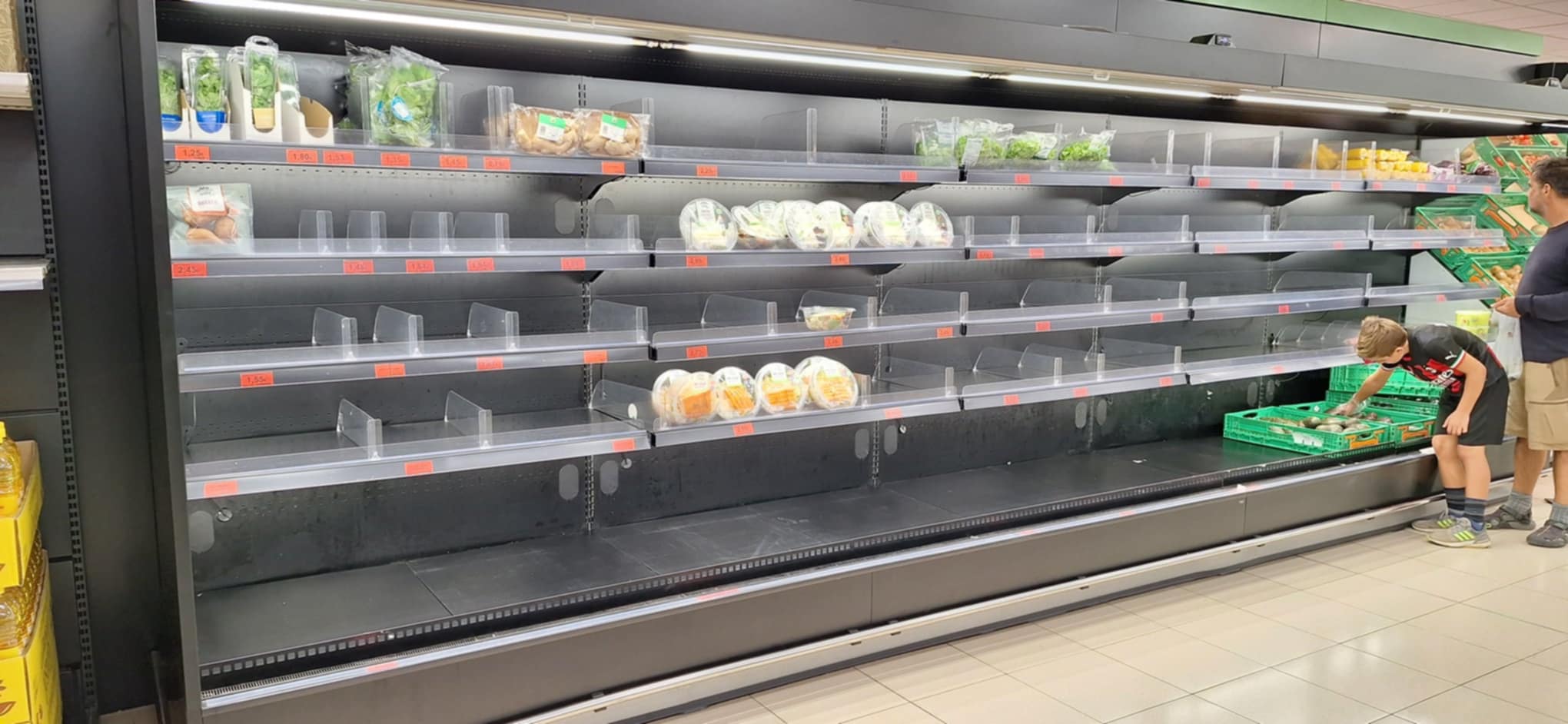
Late on Saturday, I went out to buy more provisions in a variety of shops. There was very little left, but I managed to scoop up what was necessary.

Nearly no fruit left in Mercadona, El Puig

Same story with the milk and dairy products

Salads and vegetables also all out of stock

Water - just some sparkling left, no still

On Sunday 3 November, the king and head of government came from Madrid to visit some of the ravaged areas. They were immediately set upon by angry mobs. There is a lot of resentment out there, and it’s mainly aimed at those at the top. People telling the heads of state and government they were four days too late, calling them murderers, and pelting them with some of the mud and silt that was still lying around in abundance.

We have to see how it’s reached this point. And it’s simple, really: the national government is led by Pedro Sánchez of the PSOE, a socialist party, and the regional government is led by Carlos Mazón of the Partido Popular, a right-of-centre party. One does not want the other to take the glory for any successes or decisive gestures of salvation. Instead, there was a huge political staring match with the loser being the one who blinked first. The toxic masculinity that has become a staple of Spanish politics really flowed over. Sánchez played the waiting game in the hope his rival would collapse, and Mazón confirmed the situation by believing that asking for outside help was a sign of political weakness from the Valencian government.

Courtesy of Memorias de Pez, YouTube. Full video HERE (in Spanish with subtitles)

We also have to look at who has responsibility for what. The Valencian government has control over law and order and keeping the peace as the Guardia Civil and the National Police come under its command. The Protección Civil is also under its control and coordinates the response, plans evacuations, and takes over places to use as refuges. The fire service is under the responsibility of both the Valencian government and local councils. Then there is the Policía Local, that controls the traffic and coordinates the evacuations. They are under the local council control only. Then there is the UME, or the Military Emergencies Unit, as well as the armed forces which are controlled solely by the government in Madrid. The Valencian government has to put out a request for their involvement. That obviously hadn’t happened because of the loss of face. A frightening realisation.

All of these points, all of these setbacks, all of these astonishing pieces of news, seemed to be conspiring to tell us something much more important: if this were to happen again we would be in the hands of politicians with very fragile egos.

A still from the Memorias de Pez video

I have known about the Land Of Nasty Surprises for most of my life. I warned Bonny Bee when she chose this place to come and live. It is not as shiny as it looks, as I had found out way back in the 1980s and 1990s. Things have hardly changed. The sun may shine most of the year; the food may be good even if it is full of pretty repetitive ingredients; the social life may go on round the clock and the bars and restaurants may be appealing. But under that superficial veneer there is not much substance.

I remember the response to Ukrainians fleeing the country into Poland in 2022. Before the night was over, there were preparations in place and a huge relief effort. Poland became the world's largest refugee camp without even erecting a single tent. I also remember the flooding in Germany and Luxembourg a few summers ago. The rescue operation was almost immediate and the governments had called for international help by the end of the first day. But here in Spain, political one-upmanship, point scoring and demonstrations of strength are more important than actually taking practical measures. 

It was this point that made us both resolved to leave Valencia for good, at some point in early 2025, all being well. We have a strong belief that there are never coincidences. And with that in mind, we will choose wisely.

Monday, 9 October 2023

From Luxembourg to Spain: Saving Private Belongings

You have 6 weeks until your kids need to go to school somewhere else in Europe. You have a house full of effects from your life. You have kids that don’t know the meaning of the phrase “tidy up”, and you need to make sure you can carry on your professional activities when you get to wherever it is you’re going. What is your first emotion? If it is sheer panic, you are probably right. But it’s the second emotion that will count, and that is focus. Focus on what you need to do, when you need to do it, and how you can get it done. Our list was daunting, the time frame virtually impossible, but it had to be done if we were to make sure our three children were to carry on their education.

It went something like this:

·       Call the real estate branch of our bank and request to put our house up for sale

·       Close down our Luxembourg office

·       Make a list of countries and cities we would be interested in moving to

·       Check out their suitability: house prices, schools and quality of life

·       Single out some schools and apartments, and start calling round (not just emailing and waiting for a reply)

·       Arrange a couple of days to go to your chosen destination in order to tap on a few doors, because estate agents don’t like to be accessible, unless they are confronted with you in person

·       Order a large container to throw out everything we don’t want to take with us: furniture, fittings, flooring, general waste, etc.

·       Gather all the other waste from the house, sort it, and throw it out: electric, paper/carton, glass, dangerous materials, etc.

·       Put all the utility services on alert that we’re going to close them off

·       Sign out of the local commune

·       Get the car serviced

·       Start gathering things we are going to need, such as different sized house-move boxes, tape, markers, bin bags, etc.

·       Begin washing all our dirty clothes and then do systematic washes of used ones, so that we can pack them easily when we need to.

·       Look for a person to keep an eye on our house until we can return to get more stuff: feed the cat, water the plants, put out the remaining rubbish on the right days

·       Start looking for a storage place or garage to get our stuff delivered to once the house is sold

·       Plan our route to our destination including booking stopovers – that would mean setting a deadline to get it all done

And start doing all this as soon as we can – no thinking “I’ll take a few more days off and then get down to it”, because we risk being assaulted by all manner of extra tasks we never thought of. Take this road, and you will find yourself wallowing in a massive pile-up of uncompleted items. Also, don’t do one and then another – juggle five or six of them all at the same time, prioritising one above the other.

We had to do all this while in the relatively close background, three screaming, self-obsessed kids on their summer holidays kept picking fights with each other, sabotaging our sorting piles, and asking us for juice, food, a push on the swing, or to fix something they'd messed up.

Anyway, first task: deciding where to go and taking steps to organise our successful installation there. As well as plenty of housing and affordable living, the number one priority above all else was finding a place with more affordable international schools than where we were currently living. I looked at various countries on the International Schools Database: Denmark had very few options, although it was cheap. France was OK, but we were a little wary of all the current social and economic problems there, plus their inclusive schooling was also not very developed. Czechia was high on the list, but its international schools were almost as expensive as Eton or Harrow – why cater to a lot of ordinary folk, when you can put the prices up and have smaller classes with just sons and daughters of bandits and oil magnates? Italy was out of the question – we went there in April to check it out and I think the hype is really exaggerated. Sweden would be tricky to carry on working as entrepreneurs. In Ireland, we could just put them in state schools and the system would take care of it, but when I saw the house prices (and the weather forecast), I got cold feet. Which is, incidentally, also what I would get if I went paddling in the Irish Sea at any time of year.

It seemed that Spain was turning out to be a serious contender. Or rather, the only contender. I checked out some cities and found many had more than enough facilities, and the house prices in many areas were quite acceptable. There were plenty of cities with international schools and many had the right facilities.

But where?

Barcelona would be great, but it has a serious crime problem and it’s full of tourists. Madrid is a lovely city but it’s a cauldron in summer. Malaga would be a wonderful place, but the driving habits there are frightening – I think it’s where even Grand Theft Auto refused to go. Bilbao, San Sebastian, Zaragoza, Granada, Cordoba, all utterly marvellous places, but possibly a little too small for what we need.

Hold on… what about Valencia?

You know sometimes when you’re looking for something and you look everywhere else except *right there* because that’s where it’s much too visible? It’s right under your nose, and that’s why you can’t see it. Like when you’re in the kitchen and you’re looking for the knife you were just using. You look around it, over it, even through it, even though it's so visible and so evidently close that you would probably put your hand straight on it if you were blindfold. Well that was Valencia: I don’t quite know how we kept on missing it on the map, quite frankly.

Qualities:

1.       A host of international schools all vying for your business, keeping the prices reasonable and the competition hot.

2.       Located at the very top of the Forbes Magazine Best City To Live In Index, ranked first in quality of life and third in ease of settling in by Internations, it has everything Barcelona has but without being Barcelona: it’s between the sea and the mountains, it has excellent food, splendid architecture, a superb social life, an impressive number of cultural events, and such glorious weather almost all year round.

3.       What it has that Barcelona doesn’t is also worth mentioning: low crime, friendly people, competent governance, and a likeable football team come to mind, but I’m sure there are others.

I had that instinctive feeling that I didn’t need to search any more. This was our next project, and hopefully the last one: we were going south – quite a long way south.

It was vital, therefore, that I went there to check it out, visit a few important schools and estate agents, and see which areas of the city would be good to live in. I booked a flight from Luxembourg via Zurich, and found a cheap room in a student residence for a few days. We had a Zoom call with one school, and they invited me to visit them when I arrived, although I felt they weren’t so keen on us. I resolved to go there anyhow, just to see the potential.

The impressive grounds were located quite far outside the city centre, in a plush neighbourhood surrounded by villas and parks. When I arrived, there was a summer English camp going on and the place was full of Spanish kids enjoying the utterly amazing facilities. But it was more like a sports academy than a school – there were copious sports facilities catering to basketball, football, tennis, golf, track & field. Inside there were classrooms with every piece of technology you could ever need – every room looked like as if the Starship Enterprise had been a children’s space ship. The immaculate marble-and-glass corridors led to different other facilities, such as a fully equipped air-conditioned theatre with seating for well over a hundred, a canteen the size of Gatwick Airport’s arrivals area, tree-festooned walkways, and a rather large trophy room displaying the school’s impressive sporting and academic achievements over the years.

The mouth-watering services and programme on offer, plus the facilities, location and fee structure made me realise that maybe back in Luxembourg we were being swindled. No, hold on, not swindled, robbed. Pickpocketed. Mugged. Cheated. Fleeced. Ripped off. Defrauded. Conned. Hustled. Deceived. Hoodwinked. Shafted. Taken for idiots. Imagine paying a vast amount of money to a school to turn your child into a fully-functioning citizen, only for them to tell you they’re not prepared to let her repeat the year and grant you the time to put in place the appropriate professional help. What kind of crapulous business model are you running when you ask thousands of euro for your rather limited and unexciting services, and you act like you are the client? What school – remember that, school – wants all of the children in its care to conform to the system rather than to adapt the school to the individual? The visit in Valencia had raised a whole new level of questions that my brain was finding hard to answer. All I could think about was that we had not yet wasted our children’s education, and it was vital that we put everything in place by September. It was the second week of July.

At the end of the rather hasty visit, the head teacher said something that made me feel we needed to look elsewhere: “we can take Livia for a week and see how she gets on.” That was never going to work for me, but one of the advantages of Valencia is that it has more international schools than the entire Grande Région, which covers 5 regions in 4 countries. So I aimed my intentions towards a lovely British school in another suburb that had similar facilities and a powerful reputation. I called them up, they immediately arranged a Zoom call for a few days later, we told the head about our situation, and she sent us the enrolment forms.

To say that this woman is a mere head teacher is doing her a disservice. She is a ninja businesswoman and astute service provider. Every email answered, even if only a few words, all procedures explained, and all steps towards onboarding in September laid out in front of us. We were in.

Next, we needed a place to live.

Another thing I did while I was in Valencia was go to some estate agents. I had the impression there were going to be some heavier obstacles in this area, especially as Valencia is quite a popular place to move to. I visited a few of them, dropped my details and what I was looking for, and never heard anything again. Except from one; and yes, another ninja businesswoman. See the previous article for details on how we procured our beachfront apartment.

I also got reacquainted with the Spanish character and way of life. I should elaborate at this point – back in the twentieth century, my family had a strong connection to Spain. We had relatives living in three parts of the country, and my grandparents had a holiday home in the mountains near Malaga. They were special times – I loved the Spanish work ethic, the positive attitude, wicked sense of humour, strong sense of community, laid-back outlook, and ability to distinguish between fun and duty. And I had a proper revisit to these feelings as soon as I landed.

It was a bizarre, disorienting feeling, though, because I had been out of this environment for well over a couple of decades. But it all felt so very familiar, so very comforting, and so indispensable at that point. If I was going to leave behind my house that I had poured 15 years of toil into, I wasn’t going to take a backwards step. And here, in this blisteringly hot climate, with the nightly wind set to hair dryer status and the daytime temperatures reaching a point where even the devils of hell had gone back downstairs to cool off, I had my epiphany. I was, weirdly, going back to my original second home.

But there was a daunting task awaiting us before we got there: there was a house full of our junk that needed emptying, we needed to throw out a lot of stuff that we hadn’t used or seen for years, deal with some crap left over from the previous owners, and find a solution for a grumpy, deaf, twenty-year-old cat called Baldrick. Oh yes, and I needed to plan our route to Spain, dates and places to stay on the way.

I arranged for a container to be delivered to the driveway, and we started to divide all the junk that couldn't go in there into categories to take to the dump, a 35-minute drive away at the other end of Trier. I never realised how much utter rubbish the average household could accumulate over time. It is amazing. I did several runs to the dump, one of them just with electric bits and pieces: old blenders, a few outdated printers, a ton of battery-operated gadgets, obsolete chargers, lamps, broken plugs, sections of the Internet, old modems, clocks, and even a battery-operated oil painting. Don’t ask me what that’s all about, I have no idea, but it was a thing left in the bowels of the house by a previous occupier. Kirsten said she supposed it played a tune. Nobody buys that kind of trash, unless it’s a gift from someone who hates you!

The days went by, July finished and August kicked in. We had boxes and boxes full of our stuff, packed high and stashed in the flat below. I went up and down the steps carrying so much of it, I lost 4 kilos in just 3 weeks. Our gardener, Benek, had also helped to get the place in order, and without him I don’t know what we would have done.

The children were on summer holiday, and they were constantly asking us when we were going on holiday. I felt bad because we had so much to do and so little time, but yes, we all deserved a holiday. We were supposed to start our rental period on 1 September, so I decided that we should finish up on 21 August and the next day make our way southwards. I would find us a good seaside holiday home near Valencia for the week before we needed to move in, and arrange a couple of places to stay on the way that would count as a holiday.

One of the best ways to experience Spain is to go to a place where the Spanish go on holiday. The picturesque town of Peñíscola, about an hour and a half’s drive north of Valencia, is one of those places. It’s a quiet, unassuming resort, but it’s a beauty. Two enormous rocky promontories, one with the old city on it, a small harbour, and some beaches in-between that are protected from the main sea.

I found a delightful house in a typical urbanisation up some very windy roads with its own garage and terrace overlooking the sea – we would stay there for our final week from 25 August to 1 September. Now I could fill in the gaps to get there. I love planning holiday itineraries, and my first and most important tip is planning backwards is so much easier. Book your final destination first, it’s really then just a matter of filling in the gaps.

I used Google Maps to search for a good place in France to stay for a couple of nights, quite a long way south. I decided we should leave early on 22 August, a Tuesday, and get as far as possible towards our end point. Ambitious, but doable. I landed on Camping et Chambres d'hôtes du Moulin d'Onclaire, near the delightful town of Privas in the Ardèche. It had a swimming pool, and we could stay in a pavilion tent under some trees next to a river. I thought the second leg should be less ambitious so we could enjoy the Ardèche more and have a shorter drive. I found a delightful little bed and breakfast in the foothills of the Pyrenees about an hour from the Spanish border called Maury Cat Studio 66, where we would stay one night before our week in Peñíscola.

It was all set, but time was pressing. I would tell you what the months of July and August were like: imagine someone gets a fire hose and sprays you for days on end. Not with water, but with an endless number of tasks. You need to do some more packing, but you also need to collect rubbish, but you need to sweep the toys up that the kids spread all over the house, but you need to go shopping for food, but you need to put some washing on, but you need to clear up the terrace, but you need to go to the council to sign out of the community, but you need to arrange some meetings with a few people to say goodbye, but you need to buy more boxes, but you need to occupy the children before they turn the place into a set from Lord Of The Flies, but you need to cook dinner, but you need to call the agent in Spain for an update, but you need to put all these things in some kind of order of urgency so that you don’t have to choose one of two impossible options later.

You get the idea.

Anyhow, by way of a miracle, we managed to fit everyone in the car on the morning of the 22nd of August. I think it was just getting to the point where we said “we’ve done enough, we can’t look at it any longer, let’s just go.” So we did, with the aim of returning the following month for a few days to put the rest in order. Good intentions, good intentions…

We unceremoniously sped off towards our new life without looking back. From what I remember, we stopped at a few places as we moved southwards, and each time, we noticed an increase in the intensity of the heat. It was really telling that by the time we reached Lyon, we were starting to flinch each time we stepped out into the sun.

Arriving at the first destination at about 7, we immediately went to the local town, Privas. Having parked the car, we headed into the blazing evening light to enjoy what was left of the day, sweat a little, and allow the children to stretch their legs. There would be no set bedtime that night, not now we were finally able to let go of many of the obligations. Saying that, I think it still took six weeks for us to fully expunge the stress and tension of the summer: for a long time, we were still quite edgy and tense, always responding to every noise or movement, and finding certain simple tasks too heavy to complete, or even start.

The day after, we spent the day at the pool just generally trying to detoxify. However, another rather silly annoyance crept up on us: the brakes of the car were worn and scraping metal on metal. I was in no mood to drive all the way to Valencia with dodgy brakes, not now we were south of Lyon, the kind of dividing line between northern and southern driving habits (with a few southern exclaves, such as Paris and Brussels – and for those who know, Esch-Sur-Alzette too…).

So I drove to a number of garages in the hope someone would be able to change them as quickly as possible. In the French countryside. In August. In a heatwave. A woman at the only garage that said it could fix the situation told me they would order the part and it would be there the following day, when we had to head south. It was the only possibility, so I took it. It was a garage about 10 kilometres from our campsite, so the assistant, a boy of about 19, was given the task of driving me back. The car was a tiny Renault Clio from about the late nineties and I had to heave my legs in to be able to close the door.

That evening, we ate at the camp site’s restaurant, a lovely courtyard terrace next to the swimming pool. There was to be a concert afterwards, and we were encouraged to stay.

There is something about the French and their stomachs that I will never understand. When the French go on holiday, so do their taste buds... and their principles. Between September and June, the French will look down upon the Americans and the British, the Dutch and the Germans, even the Danes, and pour scorn upon their eating habits, always dwelling on how superior their food is (despite there being a lot of cross-over), and yet when you go to any French holiday resort, the only thing they’ll serve is brown or orange-coloured fried food, often straight out of the freezer. There’ll be nuggets, breaded chicken, croquettes, fish sticks, meat balls, these thin, quick-cook fries that crisp up if you leave them in for a minute longer, and they’ll put them all in the deep fat fryer. There will always be loads of ketchup, an almost blasphemous ritual that the French seem keen on keeping alive as soon as July and August roll round. I remember my mother refused ketchup in the house, but in France, this is the summer staple. And they’ll charge you as much for this fattening brown pile of factory-made offal and plant-based leftovers as your local restaurant back home would for a decent salad, followed by an entrecôte, vegetables and potatoes roasted in garlic and rosemary, plus dessert and a glass of decent red wine. Not to forget a proper coffee, not the powdered crap they lazily make themselves as soon as the calendar reaches July. The French will forever bang on about their “marvellous cuisine”, even trying to bully UNESCO into giving it World Heritage status, yet they themselves are close to the top of the world rankings for fast food consumption. Go figure.

Anyway… rant over, back to the point. The evening passed well enough, and we had a lot of fun with everyone else at the concert/party. The performers, a man with an electric guitar and a digital mixer, and a woman vocalist, both local, would regale us with some proper rock songs, many in English. This, despite them not speaking a word of the language. They played really well and their hilarious pronunciation of the English lyrics was just the tonic I needed to cheer me up. I loved Suite Homme à la Bama by Aerosmith, Wok Ziss Ouais by Aerosmith, Ail Oué Tou'elle by AC/DC, Aneuze Houane Bail Tzeu Deust by Queen, Aille L’oeuf Roquenrol by Joan Jett, and Chize Gotze Louque by Roxette. Despite that, they were a lovely pair, and they really knew how to get us all dancing. I’d have hired them if I lived locally.

In the morning, I called the garage to see when I should come and get the car. They said the part would be in but they weren’t sure when. The prodigiously long, unnecessary rural French lunchtime came and went, no car. By 3pm, I was crawling up the walls. We should have been gone by then – our hosts for that evening were preparing dinner for us, and it was 360 kilometres away. Another intolerable hour ticked on, no call. The children were having a thoroughly great time all day at the pool, so the fact that Daddy was having an internal meltdown was immaterial.

Finally, at about half past four, the garage called to say the car was ready, and the boy would pick me up in twenty minutes. I told Kirsten to have all our belongings waiting outside the tent and went there expecting to pay, pick up my car keys and get the hell out of there. Nope. The client before me had a list of demands and gave an explanation each time: “The front left tyre might need some air – I was driving back from Carrefour on Tuesday – or was it Monday? Oh no, it wasn’t Carrefour, it was Leclerc, and there was one of those potholes that you can’t avoid. The local council should be ashamed. Anyway, I didn’t see it until too late so I was going too fast. Must have been about 40. Could have been faster though. Anyway, it hit the pothole and my coffee went all over the dashboard, I dropped my cigarette on the floor, and the suspension took quite a hit.”

Oh please STFU, I have a bunch of kids thinking Daddy’s hidden the car somewhere and I have to be in the Pyrenees by 8. I interrupted the conversation after a while and the chatty guy said “oh, I didn’t see you there!” I wanted to say, “yeah, no surprise there… you’re so self-absorbed, no wonder you hit a massive pothole. Why don’t you move your gaze away from the end of your own nose, you boring old troll, and take a wider look around you!” But instead I said “sorry for interrupting this pleasant little conversation, but I do have quite a pressing need for my car.” Regretfully, I held in my utter rage, because despite firstly the little devil on my left shoulder telling me to give any idiots and time wasters a good verbal slapping, and secondly the lack of an angel on my right shoulder keeping me virtuous, there is a terrifying Kirsten-shaped leviathan at home waiting to murder me for not having a placatory, well-meaning, non-confrontational attitude, even among people who really need to be told they're the main problem in their friends' and family's lives.

It’s a weird, paradoxical, almost hypocritical situation: she has a distaste to point out other people’s idiocies or despicable attitudes, so as not to cause a diplomatic incident, or worse, to offend the bastard, yet I might get a full half-hour sermon on putting too much salt in the pasta water. Believe me, the feeling of self-loathing for not telling a stranger he’s cycling in the middle of the road by hooting my horn loudly right behind him is better than the Full Kirsten Lecture awaiting me if I did do it. But sometimes temptation does win, and I will take the verbal fallout heading my way.

We hit the road at twelve minutes after five. I sent a message to the hosts with our excuses but that we were definitely on the way, and they said not to worry, they would wait. Having committed a few minor traffic infractions, we got there at two minutes after nine, and it was truly worth the stress – from the front, it looked like an unassuming row house on a very steep hill with some very dodgy surfaces, but the view on the other side was simply breathtaking. You walked through a huge room containing a proper, professional kitchen, passing tasteful but engaging décor, into the adjoining entertainment room containing an immense dining table, and a circular sofa for properly cosy moments (I’m quite sure that sofa could tell a few stories).

Our hosts were a couple in their fifties with the attitude and outlook of people half their age. They were in the midst of preparing our dinner when we arrived, so we were escorted to our room. We left through the back door, where there was a terrace overlooking the slope, and up a metallic spiral staircase to a huge wooden platform. Our room was through some hermetically-sealed sliding doors. It was so perfectly laid out in a nautical style and even had a mini cinema at the back. The children’s room was off to the side and had enough playful accessories to keep them entertained, but it was the terrace that was the star. It was dark, the moon was coming up, and we could make out the mountains in the back, the valley below, and the trees straddling the river. I was impatient to see what it looked like in the morning…

Dinner was served – a truly impressive salad to start with, which could have filled me up on its own. But then came a dish of local sausages, potatoes and summer vegetables. Believe me, about five years ago, I would have eaten the lot. But then, I was 30 kilos heavier and had a penchant for assuring an empty plate.

Dessert was equally delicious, and we were thoroughly impressed with the entire experience. We moved to the terrace, where it had got a lot cooler, for cigars and a nightcap, then we went off to sleep. Our quarters, up the metallic spiral staircase, were not to everyone’s liking… Dainoris needed his hand held and Milda was a little sceptical to start with, but in the light of the morning, I was sure the situation would be different.

And yes, it was.

I woke up with the anticipation of a child on birthday morning, and went over to open the sliding doors and the shutters. I lost the ability to breathe for a few seconds – the vertiginous rocky mountains, the fertile valley, the length of the view along the river – it was all so immense, so wild, so raucous in a silent kind of way. I could happily have just decided to move in there and then, but there were three kids to take to a holiday home in Peñíscola, and then there was the little matter of our new life in Valencia.

After a proper breakfast, we thanked our remarkable hosts and once more got back in the car. An hour passed and we crossed the border into Spain. The borders between countries in the EU are becoming more and more difficult to discern, and the difference in my lifetime of crossing into Spain in the 1980s compared to now couldn’t be more stark. Back then, we had to pull up at a huge roadside installation and show our papers to some very strict-looking geezers in odd hats and uniforms who used to make a habit of confiscating cameras, even if they had remained in your bag the whole time. How on earth they could suffer the heat while wearing a buttoned-up shirt and blazer was as baffling as the procedure they put us through. On this journey, we hurtled over the frontier without even thinking about it… it wasn’t until I saw an advert for a restaurant serving tapas that I realised we had left France. The European Union has a lot of detractors – but it has made our ability to move around so much easier. We would never have been able to do what we did back then: just pick everything up and dump it 1500 kilometres further south without even needing to show our passports.

We drove some more through the flourishing landscapes of Catalunya, deciding to pull off the motorway near Lloret de Mar, where there were surely some places to stop for lunch. We found a roadside restaurant that had ample parking and I put our long-suffering car under some trees.

After what was a perfect “Welcome to Spain” lunch, we jumped in the car and headed to Peñíscola, still quite a long drive away, passing exit signs for some of the country’s most well-known tourist destinations: Palamos, Tossa de Mar, Calella, Blanes, Sitges, Salou, not forgetting Barcelona, then crossing the Ebro valley before reaching Peñíscola itself. The children were veering between quietly interested in the scenery outside, to boisterous and annoying. So it was a particular comfort when we arrived in the town. I just had to get the keys from the tourist bureau on the other side of the town, and we’d be all set for our well-deserved holiday.

The town itself is a bright, friendly and laid-back place with a mix of restaurants and bars, tourist tat shops, and mid-range clothes boutiques. There are two main beach fronts on each side of a huge promontory containing the old town, with its castle on the top, seeming to rise out of the land like a massive organ in a theatre. So the first thing we did when we arrived at about five-thirty and got our keys was to change and head to the beach. The evening warmth kept everyone on the beach until after half past eight.

The children released a lot of energy that evening, both there and at the restaurant we went to after, a ranch house with a sprawling tree-speckled complex of tables and chairs, benches, chaises longues, sunbeds and deckchairs surrounding a small raised pool with a bridge over it. The Steakhouse El Campo is a seasonal venue open while there are enough summer tourists, and it’s run by a German man and his son. The Vater runs the restaurant in and around the ranch house while his Sohn runs the outdoor bar and grill near the pool.

Now we really felt like we were on holiday. During the week, we just did some typical tourist activities – visiting the beach, going to the park, walking in the cool night air, going to bed reasonably late, and eating local delicacies. We visited a lot of great restaurants and other places to eat, such as Hogar El Jubilado, an old-style hostelry owned by the local council and run by an elite team of workers. You queue up to make your order, they prepare it there and then, and by the time you’ve paid for it, it’s ready. There were potato salads, seafood salads, Russian salads, tortillas españolas, meatballs, cheeses, fresh fish dishes, chicken drumsticks, and a whole 1-and-a-half-metre-long fridge with whatever dessert you could desire. They opened for breakfast at the crack of dawn with croissants and pains au chocolat and closed at midnight after the last beer was poured. It was the town’s beating heart, and the people working there were happy, mischievous and highly efficient.

You can tell the quality of the place by the amount of insolence they are willing to hurl at you, and this place was right there at the top. Their coffee was tremendous and so was their teasing. It was here that I said to myself “I think we’re going to be all right.” I’ll be honest with you, I was still in mourning for our old life, and I often had moments when I just wanted to cry. Looking back, it was compounded by a deep fatigue from all the hard work before we left, but it didn’t take away the sting from having to uproot the entire family from everything they knew.

All I can say is the younger three were having the time of their lives, and the last thing on their minds was returning to our former house in Saarburg and going back to any schools in Luxembourg. And that was the most comforting thing. Because after this week, we were to start our new lives and they were to go to school.

But that is for another post. 


Friday, 3 December 2010

How much did it cost, Mr Putin?

So Russia has won the right to host the World Cup in 2018.

Take a look at the following press freedom rankings of the candidate countries:
The Netherlands (3)
Japan (12)
Belgium (14)
Australia (18)
The UK (19)
The USA (20)
Spain (39)
Portugal (40)
South Korea (42)
Qatar (120)
Russia (140)

Now, considering the alleged backhanders and oiled palms that took place in the bidding process, I regard it as a badge of honour that England was last in the votes. Australians should feel proud that their democracy came last in their own election for 2022.

I do not mind whoever won, but the way the day progressed frightened me - is this a sign of the future? I would prefer my country to have press freedom and my human rights respected than win the right to host a football competition in which even the goals scored might not be given because FIFA refuses to allow TV replay evidence.

I hope the UK press is galvanised into running a deeper-than-deep investigation into the dealings of that self-appointed, self-important, self-deifying group of stuffed suits.

There are three places the UK press needs to look:

1. Why did Blatter say China invented football? I knew the writing was on the wall then. After that, he gave a less-than-convincing speech on the need for the losing countries to accept the decision of FIFA. In other words, "we've been doing things behind everyone's backs and we're really worried about the reaction of the losing bidders."

2. Why did 5 members of FIFA tell David Cameron that they could be assured of their votes which then never materialised? Blatter's speech to FIFA delegates just before voting may have had something to do with that, where he told the voters to remember the recent criticism directed at their organisation when they cast their votes.

3. The last place the UK press should look is the pockets of every FIFA member, to make sure they're not getting too full.

I, for one, would welcome this media intrusion. I didn't mind the fact that England lost the voting. I never thought it would win. But the manner in which it happened suggests there was something not right in the voting process.

This is also a mirror of the intransigence which FIFA deploys in regard to their refusal to allow TV evidence to assist referees. It is a powerful hint that it is not in their interests to allow certain results to interfere in the smooth coronation of the world champions.

I have always had a dark brown suspicion that World Cup winners were not always the teams that played the best. Now I am wondering how much it costs a country not just to win the right to host, but to win the World Cup itself.

Well, why don't the larger countries get together and break away from FIFA, set up a rival code and then see who blinks first... Spain, Portugal and Italy would relish the chance to join a breakaway group with England. Then the Germans and Dutch might feel a bit lonely as the biggest European footballing countries still clinging to FIFA. And as the only two larger countries left, a little like the Scottish football league, the Celtic and Rangers of world football, Argentina and Brazil, would not take too long to switch suits either. Then the torrent would come led by France, the Czech Republic, Japan and Scotland. In the end, only Switzerland, Qatar and Russia will be left. They can set up a proper, fan-based democratic football union run on the basis of what is really good for the game.

It'll never happen though. Too many threats from FIFA will see to that.

Now let's get back to playing (mainly) honest sports like cricket, golf and rugby.