Showing posts with label US. Show all posts

Tuesday, 21 February 2017

The truth takes too long to explain. It's time to rectify that.

The problem with human beings is they only live for 60 to 90 years. That is hardly enough time to learn how to make the world a better place. The other problem with many human beings, although fortunately not all, is their laziness: they have a tendency to strive for simplicity and they like complex explanations to everything packaged in neat comprehensible bundles that they can relate to, whether they are correct or not.


Throughout history, humans have tried to better themselves. They have gone from a short, brutal existence in primitive conditions via controlling fire, harnessing electricity and championing human rights, to supersonic flight, connecting everybody through computer screens and curing fatal diseases. Humans have forever been improving others' conditions, but they have not always raised their standards on a personal level.

What do I mean? Well, look at the vast majority of inventions. They have been created to make our lives better, because we are as a species particularly lazy. We will go to great lengths to reduce the need to go to great lengths. What these inventions, discoveries and adaptations do not do, however, is raise standards of intelligence and behaviour in people. They unfortunately go for the lowest common denominator, and if that's not available, the shortest and crudest explanation. This is what we need to correct now.

What has laziness got to do with it?
Well, look around you. People strive for the latest gadgets and machines to make their lives easier. They want them so badly, they'll go out to work for 8 to 12 hours a day to earn the money to pay for them. It's quite a paradox actually, when you think of it. We invest in clothes driers so we don't have to spend twenty minutes hanging up clothes on a line and wait several hours before removing them. Some of us then hire people to iron them for us.

We buy cars to go shopping even if there is a supermarket just down the street so we don't have to cart a couple of bags of acquisitions a few hundred metres, even if a shopping trolley costs a fraction of the price and the exercise would do us good. We buy kitchen appliances so we don't have to whisk, mix, stir or beat food ourselves, and we programme a destination into a map-reading machine so that we don't have to use our brains to read maps ourselves.

We constantly seek to take the effort out of our lives but we run ourselves into the ground getting there. We strive for simplicity in everything, though, including how we consume information, which is why many people are more willing to accept a snazzy slogan from a demagogue than listen to a full-length explanation from an expert.

In fact, people seem to have grown weary of professionals and experts altogether. And this is where the danger lies - politicians, big business people and captains of industry don't get where they are today by being lazy. The cleverest and most ambitious ones use the language of the lazy consumer to persuade, cajole and steamroll their targets into buying their products or supporting their policies. They can make people dance to their tune and wear clothes according to the weather they make. They get out of bed before they've even got into their pyjamas.

I am not saying this is nefarious behaviour; I am saying that they know how to play people's tunes. And there are a lot of people willing to be led. The fashion industry is the most extreme example of this - some rich tycoon with a clothing idea sends a faithful acolyte on TV to say "this is the latest fashion accessory", and before the Y in "accessory", it is sold out and a clamour for more engulfs the shops. If many ordinary people are willing to listen to this useless information about fashion which, let us be frank, has little or no impact in the whole scheme of things, they will of course treat important topics in the same way. And this goes for voting patterns too.

I would go as far as to say that the brutal treatment demonstrated in public voting shows on TV (the hollow commiserations handed out by the hosts, the cruel wait before the announcement, the gossip on the spin-off shows and in the newspapers, etc.) have made many people collectively immune to the feelings of others. People talk about these victims of fame as if they were characters in a soap opera. Added to that, we see evidence of people filming others involved in accidents or being attacked without intervening. Our civilisation is becoming immune to people's suffering.

And this is also reflected in recent political events.

The first that I can bring to mind is the refugee crisis in the Middle East and its spillage into Europe. Leaders of countries are ordering massive fences to keep out people fleeing for their lives and accusing them of carrying diseases into Europe, or worse, of shielding terrorists in their numbers. The problem is the opposite opinion is not an effective counter-argument - that we should allow these people in regardless is not going to win over many neutrals. This whole débâcle has sunk into mud-slinging and blaming each other for either being too hard or too soft. But those in positions of power are too proud to let go of their pet hates and any productive debate is stifled by the constant accusations. Western politics is sinking to lows that will take revolutions to amend.

Furthermore, we can point to the US-Mexico wall that the current incumbent of the White House is so adamant will be an effective antidote to illegal immigration. And this is where human laziness really reaches its nadir - symbolic gestures are seen as effective solutions to people's ills. For that is what the wall on the southern border of the US will be - a symbolic gesture, nothing more. People will go over it, under it, through it and around it. And symbolic gestures are happening everywhere. They stem from human laziness and unwillingness to investigate too far into something in case it turns out to be wrong.

Take the Brexit bus.
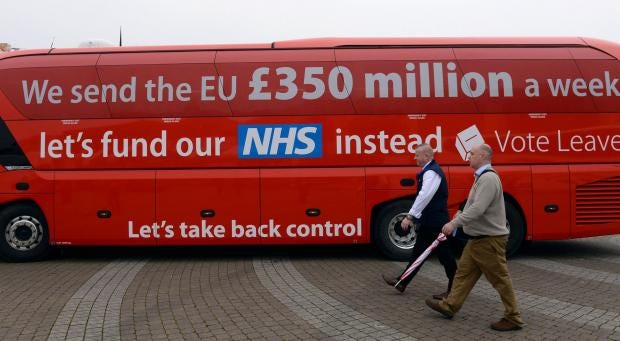
Image result for brexit bus

Never was such a succinctly effective untruth so widely used, and accepted, to justify an argument. The other side of the coin, though, cannot be emblazoned on the side of the bus so successfully:

Related image

And herein is the underlying problem - the arguments for and against any subject generally have on one side an attractive soundbite that makes perfect sense to people who like their news in short paragraphs; whilst on the other, a complicated narrative with detailed explanations can confuse or bore the average reader. Guess which story is likely to garner the most supporters...

And that is the disadvantage of those who seek to explain the truth and justify their answers in more detail - they can easily be drowned out by heckling from the opposition, or mocked for their unwieldy explanations. Short, snazzy slogans are the domain of commercial retailers and sports teams, but the political classes are getting in on the act, and taking their ideologies, warped or not, to the wider public. Unfortunately, and I don't think I am going to gain many friends by writing this, but there is a large section of the population that is easily led by simplistic messages that claim to be able to improve their lives, the very basis of commercially successful strategy. Taking this out into the real world is both reckless and unfair. The truth becomes blurred by people wishing it true, no matter how false it is.

The BBC has recently set up a Permanent Reality Check team to look into stories and claims that have been flagged as containing an element of untruth or spin. As you will see from its detailed clarifications, the answers are more complicated than the text they were originally packaged in.

If we are ever going to break the cycle of untruth, we have to simplify the message of truth. how could Brexit have been prevented? Simple, positive messages showing the benefits of the EU would have garnered a lot more support than the Osborne-Cameron fear campaign. Take the Facebook group WhyEurope - they have been developing positive slogans in support of Europe for a while now, and many of them bring the positive side of the story into a far more easily comprehensible light:

"Europe because...
We all have better things to do than waiting at borders."

"Europe because...
You receive the same medical care abroad as at home."

"Europe because...
I don't want to pay custom fees on Amazon"

"Europe because...
it's like being rich - you have 28 different places to live."

"Europe is like a window...
Often invisible, but you're gonna miss it when it's broken."

If only this group could have got this type of message out before the Brexit referendum... But of course, these positive features do not ring with people who aren't as greatly affected by them as they are by more pressing needs, like their health, social security, employment and domestic lives. Which is why their disenfranchisement will lead them to seek scapegoats and form up behind a cheerleader who will promise them sunnier times ahead, even if that may clearly not be true.

Populism does not need to speak the truth; it needs to press the right buttons. Which is why Donald Trump and his team could think up non-events like the Bowling Green massacre that never was, and the much-derided Sweden incident. People want to believe in Area 51 cover-ups and refugee rape stories in Germany. They want to believe it so badly because they are desperate to be right for a change. They have spent decades being told they are at the back end of society, misfits, plebs, rabble, and now the Establishment is teetering on the brink of self-inflicted destruction, those who get out of bed early on the opposing side are seizing their chance.

The only way for the current political class to salvage this is to shine an equally positive light on the future rather than the incessant sad music being they play while forcing through austerity policies on the poorest of society. Governments insist there is no money for schools, public transport, healthcare, welfare and job creation, yet there is ample money for defence and meaningless vanity projects. The current batch of politicians like Schäuble, May, Juncker, Rajoy, Hollande and recently Renzi and Cameron, seem (or seemed) to be doing very little on the surface to quell the fears of the impending downfall of Western civilisation, just carrying on as normal while all around ordinary people are growing tired of hearing about the closure of hospitals here and the reduction in police there, while third countries that are not so friendly to the West are now so obviously trying to infiltrate the system by subterfuge. People are looking for a sign that everything is all right and these dark times will pass.

If the West is serious about keeping up its standards then it needs to find some visionaries and statesmen and women from somewhere. The space is full of politicians acting like glorified civil servants, more worried about their own opinion poll rating than doing what is needed to re-calibrate the situation; any shining lights are extinguished by being marginalised by power-hungry politicians or disillusioned by the rigidity and intransigence of the political system.

It's time someone with a positive vision and two very sharp elbows stepped up before the populists get there first.

Friday, 11 November 2016

Don't bring your religion into politics and count on my respect


I have been utterly astounded by the number of people whom I have come across, on Facebook, in the media, or in person, who vote for political leaders based on one point only, no matter how relevant their other beliefs are for them. This is a very blinkered and self-defeating point of view, and the biggest share of this went to Christian fundamentalists, the vast majority of whom turn out time and time again for one party in many countries that best represents their chance to implement their ideologies, no matter what else the party believes in. We saw this in Poland, which swept the conservatives to power, and now we have seen it in the US, where the Republicans have steamrollered their way to all three houses.

In 2015, the Polish elected the Law and Justice (PiS) party to power, thanks to a growing dissatisfaction in rural areas with the speed of reforms implemented by the previous incumbents, Civic Platform. Although it is understandable for people to vote out a party that has ignored them, there were many who voted for PiS based purely on their sympathies with the Roman Catholic Church in the country. Since PiS was elected, it has taken a sledgehammer to the democratic institutions that were set up to assure constitutional equilibrium in the country, has tried to totally ban in-vitro fertilisation and pregnancy terminations (unsuccessfully) and tried to gag the independent media outlets.

Many fundamentalist Catholics in Poland would never consider voting for another party, and most certainly not for Civic Platform, the party that upheld the right to abortion in a vote not long before the last election. On 3 October 2016, the proposal to ban abortion outright brought Polish women of all kinds out on strike in a huge act of peaceful civil disobedience. Two days later, many politicians had begun to distance themselves from the proposal and an amendment was being considered at the time of writing this.

The irony is, the PiS (standing for Law and Justice) party claims they helped overthrow the Communist regime along with the Catholic Church, so they feel a little like they are owed a debt of gratitude for bringing about democracy, and yet they themselves have the most undemocratic agenda since the fall of Communism in 1989. So much so, a group of intellectuals and moderates established the KOD (Committee for the Safeguarding of Democracy) as a counterweight to the encroaching reduction in freedoms taking place in the country. What they want is closer to a theocracy than a democracy, and the people are finally beginning to realise the consequences of their actions.

The moral (pardon the pun) of the story here is, do not force your ideology on others. If you don't want to be involved in, or even inadvertently condone, something that you fundamentally deplore, that is your right. But it does not mean you should force your view on others by voting for a party based on one point of obsession. This is not how democracy works. Democracy is inclusive, and one size most certainly does not fit all.

Now we turn to the other side of the Atlantic, where the Republican party has won the right to govern the United States for the next four years. There is a great paradox between people with Christian values and the parties they vote for, the vast majority siding with the Republicans.

Let us take a look at Republicans' policies and compare them to Christian values:

So, to start with, they want to keep God in the public sphere. All's well and good if you're a Christian then. But dig a little deeper and the truth is very muddy.

Christian values stipulate that one should do unto others as you would do unto yourself, including:

  • giving shelter to those in need; 
  • providing help to the sick and the poor; 
  • not killing your fellow human. 
And yet the Republicans strongly oppose giving asylum to those who have come to the US for a better life, they wish to foist medical expenses back on the individual and advocate the reversal of the weapons restrictions introduced under Barack Obama. Upon further consultation of policy one can see the Democrats favoured these points. Who is more closely aligned to Christian doctrine in these areas? I know who I would say...

Then there are thorny issues like same-sex marriage and abortion, both favoured by the Democrats and opposed by Republicans. These issues are relevant to far fewer people than those in the preceding paragraph, and yet they are the Republicans' most fertile hunting grounds for opposition supporters. So what this suggests is that, despite the fact that Jesus himself is recorded as hanging around with socially stigmatised groups like prostitutes and ex-criminals, this is irrelevant when it comes to Christians' political behaviour in modern times.

We can ignore the hundreds of thousands of people on the poverty line who are about to have healthcare added to their list of debts; rough up and throw out any under-the-radar immigrants who are doing all the jobs Americans don't want to do rather than give them an amnesty; and risk our lives by going out onto the street hoping not to meet a testosterone-fuelled sicko with a gun licence who can kill at a second's notice. Forget that, because hold your horses, folks... love between two people is only right and proper if they're male and female, and we shouldn't allow anyone to make sexual "mistakes". This is really rather creepy, but yes, fundamentalist (emphasis on the mental, and most definitely not on the fun) Christians would rather vote based on such kneejerk matters such as that rather than on the bigger issues.

The same goes with the environment:
It is entirely feasible that the next energy secretary will be a climate change denier. Despite all the warnings, the evidence and the fact that nearly two hundred countries have signed treaties to deal with it, the US is probably about to assign this job to a sceptic. Christians are split on this issue, although time and time again the Bible tells humans to respect the Earth:
Leviticus 25:1-7 and 23; Psalm 24; Ezekiel 34:18; Matthew 6:26; 1 Timothy 4:4; the list is endless, and they all point to the need to look after our planet. So one would think, that even as a sceptic, one would at least be respectful of our Earth and Her resources. But most Republicans favour withdrawing from environmental treaties and reigniting the fossil fuel industry.

Again, this is considered a side-issue by many fundamentalist Christians, because moral behaviour is a far greater threat to them than this. And to be honest, I find it at best very distasteful, at worst profoundly hypocritical. But most of all it highlights the easily-led, knuckle-headed narrow-mindedness of people (or sheeple, considering they are a flock) that:

  • they would elect a party that condoned the widespread carrying of guns yet called themselves "pro-life"; 
  • would listen to their priest telling them the story of the Good Samaritan and then immediately join a demonstration against Mexicans or Muslims; 
  • would read from 1 Corinthians 13, which even for a non-believer like me is the best definition of love in existence, and then go and heckle an LGBTQ event. 
I remember I once knew a Baptist minister's daughter who, despite the deep unpopularity of John Major's government in 1997 due to the in-fighting, the scandals, the remoteness of the ministers and the institutionalised corruption, declared she would vote for him because he went to church. Did she even pay attention to the news...? I doubt it.

And this is my problem with religion interfering in politics. You cannot blindly let yourself be guided by priests, bishops and cardinals on the very narrow moral issue of sex and love which, by the way, they don't even take part in (if you don't play the game, you can't expect to make up the rules), and at the same time have a clear conscience on other issues of a more urgent nature, like the rising oceans, civilian gun crime, free healthcare, proper education, housing the homeless and welcoming refugees. The Statue of Liberty itself has these words:

"Give me your tired, your poor, Your huddled masses yearning to breathe free, 
The wretched refuse of your teeming shore. 
To spread the light of liberty world-wide for every land."

If this is what you believe, then you are most definitely not a Republican, but you have probably been made to believe that you are by more eloquent people, or cajoled into voting for them by peer pressure, pressure from your elders or by your sheer blindness to the real issues.

I think it's only right to see that Bible verse in full. Learn from it, because it sums up not only what one might call "conventional" love, but also that for the Earth, for our neighbours, for our fellow humans, and our country:


"If I speak in the tongues of men or of angels, but do not have love, I am only a resounding gong or a clanging cymbal. If I have the gift of prophecy and can fathom all mysteries and all knowledge, and if I have a faith that can move mountains, but do not have love, I am nothing. If I give all I possess to the poor and give over my body to hardship that I may boast, but do not have love, I gain nothing.
Love is patient, love is kind. It does not envy, it does not boast, it is not proud. It does not dishonour others, it is not self-seeking, it is not easily angered, it keeps no record of wrongs. Love does not delight in evil but rejoices with the truth. It always protects, always trusts, always hopes, always perseveres.
Love never fails. But where there are prophecies, they will cease; where there are tongues, they will be stilled; where there is knowledge, it will pass away. For we know in part and we prophesy in part, but when completeness comes, what is in part disappears. When I was a child, I talked like a child, I thought like a child, I reasoned like a child. When I became a man, I put the ways of childhood behind me. For now we see only a reflection as in a mirror; then we shall see face to face. Now I know in part; then I shall know fully, even as I am fully known.
And now these three remain: faith, hope and love. But the greatest of these is love."

So on that note, if you vote based on one narrow issue of religious doctrine, don't expect me to regard you as an example of moral fortitude, for you have done nothing more than condoned a sort of "Christian Sharia" - the imposition of your religious doctrine in our law and politics, where people of other religions need to coexist. The content of Sharia law is totally different to Christian teaching in many aspects, but I don't think anyone would agree that Christianity should be applied to our laws. This is why, even in France and ultra-Catholic Italy, religious symbols are banned from state workplaces. Religion has a place inside people as individuals - it is a very personal thing. It has no place in a one-size-fits-all public sphere.

So please, keep your own beliefs to yourself, and don't impose them on others.