Showing posts with label UK. Show all posts

Friday, 13 March 2020

What is true freedom? Discuss...


Freedom. Liberty. Two words thrown about as a weapon by the right against perceived state intervention and by the left against a corporate takeover of civil society. But who is right? Both? Neither? I can tell you my version of freedom, because I have recently given much thought to it. I am sure some others have already thought up the same, so I apologise for reinventing the wheel, but I wanted to cast an eye on it at this current time when politics in the Western world are in an ultra-rapid state of flux.

I was sitting in various places in my garden and on my terrace one late-spring weekend last year, looking at the newly-planted apple trees and watching a family of blue tits flitting from branch to ground to wall and back to branch. It is one of my greatest pleasures to watch the wildlife enjoying the product of several summers' worth of planting and landscaping, experimenting and seeking advice over attracting all manner of living things with wings, hooves, antlers or tails to grace my garden and the meadow just beyond it.

I rarely play music in the garden; the songbirds make its theme tune. It has been visited by deer, foxes, kites, hawks, song thrush, squirrels, wild boar, even a trio of stray cows that had broken out of their meadow on the hills above our land and fancied a nibble of our grass. Sitting out there is better than anything else. Apart from the exhilarating and highly amusing company of my children, of course.

And that's when it hit me.

This was freedom: the absence of worry. Here I was, sitting in the garden I had conceived, smoking a cheap cigar, listening to the sounds of nature, contemplating life's knottiest questions.

But why?

When I sit outside, the only things that bother me are if I see some weeds have grown back where I  or my gardener had recently removed them, or when a neighbour decides to light a fire. Pretty petty stuff, really, in the general scheme of things. Freedom, to me, is the absence of worry, and the cleanness of the conscience. Let me explain.

Absence of worry includes not having to think where your next meal is going to come from. Or not having to decide whether to default on the electric bill to pay school lunches. Or having utility bills low enough to not notice the payments leaving your account. Freedom is being able to walk down any street knowing you're nearly totally safe from accidents, fights, shootings, natural disasters and reckless driving, unless you do something reckless yourself; leaving a hospital after treatment without a huge life-changing bill hanging over you; the ability to jump in the car and drive across three international borders on a short road trip; not needing to worry about your children's safety in school as the only drills they practise are fire drills; and being able to sit in my garden typing my own opinions on anything I feel like.

What about the cleanliness of the conscience? I don't mean piety or sinless behaviour, as I get the feeling most religious types are never free of their torment. I mean feeling not guilty for the actions and decisions you take. No regrets, in other words. I am a firm believer that not every crime is immoral and neither is every lawful action moral. I give you the example of activists, whether protesting the climate emergency, LGBTQ rights, the destruction of public land, or just supporting the opposition. In other words, those who believe in their causes to the extent that they get put into prison, not just in countries like Russia, China or Equatorial Guinea, but in Poland, Hungary, the UK and the US too.

I also mean the compromising of morality for the sake of profit, for example Western countries that turn a blind eye to the horrors of Chinese brutality against Uighurs, Tibetans or Hongkongers to keep trade going, or the selling of weapons to inhumane regimes such as Saudi Arabia. Where does one sit with Israel? I deplore antisemitism, or indeed any -ism against fellow sentient beings, but I am very comfortable in saying that I am passionately, even fervently, anti-Netanyahu and everything he stands for. Peace must come, but it cannot come while anyone who believes in the right to statehood and self-determination for Palestinians is accused of being anti-Jewish. This is an overreaction designed to silence anyone who questions them and their unlawful behaviour.

As I sit here typing this out on a Chinese laptop, with a Logitech keyboard made in China, I realise I am also contributing to the suffering of others, but consumption guilt at this level is only avoidable with extreme pickiness and a lot of hours spent questioning sales staff in computer shops as to the provenance of their wares. Instead, we need to make it clear to suppliers that their pursuit of profit is what is driving this enriching and rewarding of nasty regimes, and that we are willing to pay more for these products if their production is moved to a place in an enlightened and democratic nation where jobs are needed. We need to pay more for our products; bring them in-house, so to say, and create more jobs in our backyards. This means we need to communicate this loud and clear to companies who switch production to places with cheap workers to save more money.

Also, cleanliness of the conscience goes for how we treat others on a personal basis. I have done things to others that I look back on with regret. I am not alone here at all. I cannot change the past and go back to rectify it, but I can show sincere remorse and make up for it by never doing it again. There are other things I have done which others would find immoral but which I have thoroughly enjoyed. I did not harm others or even come into contact with others while doing them, or even make anyone feel uncomfortable or embarrassed. There are people who would consider them immoral, nonetheless. I really don't care what they think, as the only thing that was harmed was their squeaky-clean and vacuous imagination.

I used to be very conservative in my views on life. I used to be quite sanctimonious and I took life very, very seriously, to the point where I had no fun at all, which was mainly due to nurture, not nature, sadly. I also expected those around me to do the same, believe the same, and act the same, so as you can imagine, I had very few friends. But slowly, as I met people who loved life, tried everything out that does not kill or harm, accepted failure and celebrated success, I realised my view of the world was silly, fuddy-duddy, old-fashioned, and was not a way to keep friends. I rejected the moralistic, moralising, morale-reducing harbinger of self-righteousness that I had become, and opted for the flexibility and open-mindedness that I had learned from various people I met on the way to being me. It was a long and tortuous journey, but it led me to finding contentment and spiritual peace.

Why am I saying this? Because in the manifestation of my former self, I was not free. Freedom is in the head more than anywhere else. And it starts with how you act towards yourself, then other individuals, then society in general, in that order. Acting honestly towards yourself is where freedom begins. It means thinking those thoughts that you used to suppress, it means switching off your own internal censor and investing in your own happiness, not brushing it to the fringes of your mind.

Freedom is a concept, not only a legal item, and we need to exercise it without encroaching on others' sensitivities or causing fear, misery, discomfort or anger in them. This is why, when I read stories about Americans and their attachment to guns, I cringe. If Second Amendment zealots really want to have their weapons, they should also balance that up with the sensitivities of other individuals and general society, especially around those who have victims of gun violence in their circle, of which there are many. So compromise needs to be found. Think of it like this: I like to play golf, but I don't play it in the town centre park; I go to a golf course, a place specifically dedicated to this activity. Likewise, people with guns should balance their wishes with those who prefer to have the freedom to walk the streets or send their children to schools without worrying if they'll come back.

Likewise, religious people can have whatever views they like, but they have no right to impose them on other individuals, or society in general. If they don't agree with women's rights over their bodies, equality of the sexes, alcohol consumption, polyamory, soft drugs, euthanasia for the terminally ill, or anything else for that matter, they can believe and practise that amongst themselves, but they should leave the rest of us well alone and not impose their narrow views on the rest. This is why, in true democracies, religion and the state are kept far, far apart. Let's face it, the teachings of most religions evoke the same basic rules: look after your fellow human being, do nobody harm, live to the full, don't judge. But it is precisely that fourth one that has made its way from religion into politics. And we should slam it straight back into its box.

For this is what true freedom is - practising what you believe is right for you as a conscientious and mature citizen, and keeping your nose out of others' business, unless you can see clearly that it is having a detrimental effect on them or those around them. This is by no means an issue of keeping the state out of our affairs; this is in fact a personal and societal one, and the sooner these matters become mainstream, like public smoking did, the more effectively we can deal with those who still seek to impose their views on us all.

I find it horrific that the very same people who complain about the encroachment of the state on their daily lives also want to use the state and the law to limit people's rights in areas they have problems with. For them, it's okay to let the state take a back seat over healthcare, guns, education, corporate responsibility, youth issues and social security, but they clamour vigorously for state "intervention" in matters as diverse as abortion, bailing out failed banks and even freedom of expression when it questions their own beliefs.

To recap: freedom is not about the ability to carry weapons in public or impose your views, religious or not, on the rest of society: it is the absence of these things, and most importantly, the absence of worry. Now before you think, "well yes, but that requires earning money to a certain level". No, it doesn't. It means that, whatever your salary (or not), you should not need to worry where your next meal is coming from. Let us take social democratic countries where it is more difficult to die of hunger than not, what do they do right? They maintain the idea that we're all in it together. Part of your taxes goes directly to providing for the most vulnerable in society, and making sure they can integrate as much as possible into normal life.

In rampant capitalist countries, it is claimed that low taxes and trickle-down economics will sort out the poverty by allowing companies to invest what they would have paid in taxes to hiring more workers. But this is a fallacy, as not only do companies cream off their profits for their shareholders first and foremost, it also encourages individualism and selfishness in the fact that people start to covet their own wealth and treat colleagues, neighbours and even family members as competitors rather than team players. Another side effect is, although you can become fabulously wealthy, you can also die destitute and hungry, or rejected by your health insurance.

We need to balance the right to live in peace with the duty we have to provide for those less fortunate than us. And that means doing what is right by our fellow humans - let us give everyone the right to live without worry: let us use our taxes to support those who need it most, whether it is by providing everyone with proper medical care, adequate and affordable housing, essential supplies, or opportunities to feel useful in society. For freedom is the right to live your life without worry, and that means money needs to be much less important. Societies need to extricate themselves from their reliance on budgets and markets.

I remember in the past when I was working for a pittance and still had to pay the bills, rent and living costs. In the UK, I dared not rock the boat even one little bit for fear of losing everything. I was not permitted to have any self-pride.

In order to deliver a society free from this in the 21st century, we need to move away from our addiction to news outlets and newspapers run by media moguls, our exaggerated commercial activities, and our feelings of inadequacy brought about by comparing our lives to our peers on social media. We need to reconnect with the society we live in, be true to ourselves, and stand by our principles. But most of all, we need to drastically change the way we live: this starts with taking steps to ensure all of us fit into the society where we live and work; be less cynical about helping others; entreat our leaders to enforce the rule of law; pay more for products and commodities to ensure their ethical cleanness, and be prepared to give up outdated privileges that encroach on the well-being of others.

Finally, we need to wean ourselves off those things that destroy or harm our planet, our only home. Cars are a necessary evil, but we can do a lot more to avoid using them too much. It was once said that to gauge the level of advancement and collective wealth of a civilised society, we should not count the number of fast cars on its streets, but the number of rich people who take public transport.

In these testing times, we all need to take mental stock of what we have and what we are going to lose if we continue to let society slide further into the abyss. We should not be reacting glumly whilst watching it happen; we should be proactively stopping the cynical takeover of our cherished freedoms by those who seek to reduce or remove our rights to freedom of conscience and make us worried about everything around us.

Sunday, 18 June 2017

Why is anti-establishment sentiment thriving even after Brexit?

Photograph: Yui Mok/PA

There was quite a gloating article in the Guardian this week on Brexit and its consequences on the rest of Europe. In a nutshell, it said that Europe had been revolted by the self-harm the UK has inflicted on itself and the instability it has unleashed on the British economy, its politics and society in general. Despite its "I told you so" theme, it is not wrong. But the battle for the soul of Britain has been hijacked by two opposing factions: the rich on one side and the poor on the other, with paradoxically the poor unwittingly doing the bidding of those who would like to subjugate them. Anti-establishment fever tilted the vote towards Brexit, not a genuine desire to leave the EU.

Oh David Cameron, what have you unleashed? In fact, I could replace the former Prime Minister in that sentence with a number of people, like the present incumbent (whoever that is at the time you read this), or maybe a few media moguls. But this all goes back decades. It is a seething collection of pustules that has been awaiting its time to spew its fetid contents all over the skin of public life and drag the victim into a chronic downward spiral of health and well-being.

There is a correlation between the Brexit vote and the current malaise in society - let me explain...

Successive governments have run public services into the ground through cutting costs, economy drives and selling off tenders to the private sector. None of this needed to happen if it were not for ideology-driven politicians whether in national government or local councils, and their chums in the private sector from lobbyists to energy conglomerates, pharmaceutical companies to building contractors. Every one of them is partly to blame for the current situation. The situation is clear: for the last 40 years, cheap is best, and to hell with the consequences. Hospitals and health workers, infrastructure building, public hygiene, education facilities and staff, police, firefighters, the military, even libraries, have been affected by the scything down of their expenses all so that governments, councils and their contractors can say to their clients (that's you), that they have been saving money in your name.

Well I don't know about you, but as far as I am aware, it's the exact opposite of that method that leads to good running of public services. Money needs to be put into their systems, not removed. That means that instead of reducing our income tax bills, VAT payments and council charges, the powers that be should be raising them, or at least looking for ways to maximise returns. When some suited chinless wonder from the richer side of public life comes on TV and warns against voting for various politicians because "your bills will go up", people need to remember that this bozo from the landed gentry is actually worried about his own costs going up. He will be the first to see a reduction in his own income because he is earning more per year than most earn in ten or twenty years. Why is Jeremy Corbyn being picked out for special treatment? Precisely because of that. He wants public services to run properly and rich dudes fear that if they do, not only will they lose money, they'll lose the opportunity to buy into them when lobbyists have finished convincing politicians to sell.

Back in the 1980s, public services were run into the ground until the public clamour to sell those services off was so loud, that this was the most logical step. It was a tactic used time and again by the then government to make the case for its sale. This was true for water, energy, gas, telephony, public transport, even security services. What we saw, though, was a change in the accountability and rights of those public services, now they were private. Trains that were before late or didn't show up at all were blamed on strikes and militant worker-related action, whereas now the services are not much better and in some cases worse, despite being sold off. Outsourcing and selling off public services has led us nowhere, except that now those services need no longer be directly accountable to the government, and ultimately, the public. It also gives carte blanche to those companies to limit pay, reduce workers' rights and entitlements, all in the name of saving money. They have effectively written themselves out of any social responsibility.

It is this selfish ideology that has led to this moment in history (and yes, this is history - PhD theses will be written about this period in the not-too-distant future) where the gap between rich and poor has finally become too wide, and where injustice in society has become plain for all to see where once it was easier to sweep it aside with gimmicks and distractions, fobbing people off with standard soundbites and impersonal press releases.

And things are a lot more complicated than on the face of it. Far from being a country that's full to bursting, as landowners, right-wing politicians and lobbyists will tell you, there is plenty of room. Indeed, only a very small percentage of the land has been built on. The real issue is that it is a country whose infrastructure has not been invested in for a very long time, and citizens' roles in society are becoming less and less welcome, and it shows:

  • the hospitals are maybe fully equipped, but many times there are staff shortages or there are not enough beds for patients, leading to dangerously long waiting times. If real investment were made to ensure there were enough fully-staffed hospitals for everyone, we would need to delve deep into our pockets 
  • you should send your child to a local school no matter its ranking, meaning that pupils are liable to be turned down if their parents try to apply for a place in what might be a more suitable school outside their catchment area, even if it is just over a designated line. This means house prices in certain areas rise, and the rules prevent any logic from being used. The fallout from this is that people are being forced to do irrational things to get their children into the school of their choice
  • the Royal Navy, once the envy of the world, is now a shadow of itself, as is the British Army and the Royal Air Force, all so the defence budget can be spent on a nuclear arsenal that nobody dare use
  • there is a huge swathe of building land that is lying unused and empty because building companies refuse to build on it, meaning prices of houses go spiralling up, but more shockingly, their untouched land turns them a huge profit
There are many more examples of this, and people have become sick and tired of being treated like commodities. They know that successive governments have cut everything to the bone, they know the country is dangerously paired back to the very limits of manageability, they just haven't joined all the dots yet, but they are slowly becoming aware of it. 

Having an ideology of saving money for the sake of it has proven recently to be a myth that has badly exposed the long-term dangers of such recklessness in playing with people's dignity and respect, and nowhere has that been more evident than in the case of Grenfell Tower in West London. What has struck me is how someone came up with the idea of saving a few thousand measly pounds by choosing an inferior cladding material in a refurbishment project to make the outside of a tower block more aesthetically pleasing while neglecting the inside, where residents - who are human beings, by the way - live.

The sentiment of grief turned to anger very quickly, leading to a general feeling of ill-will towards the Prime Minister, the government, Kensington and Chelsea Borough Council, and various contracting firms. This is not surprising, but it is a microcosm of UK life in general. The protests we saw in Whitehall and at Kensington Town Hall are just a spit in the ocean of general British dissatisfaction with the way life is going at the moment, and this is manifesting itself in so many ways.

The Brexit referendum last year, in my opinion, was won by a three-way split between different sections of the public: 
  • easily-led individuals who believe everything that the right-wing press tells them, as well as unadventurous, stay-at-home monolinguals who know nothing about the wider world except the two-week drunken jaunt they undertake every summer to some touristic Mediterranean concrete jungle
  • people with vested interests in pulling out of the EU, such as some unscrupulous employers, financial investors and politicians, who have been heavily sponsored to say negative things about the EU, and finally
  • genuinely disaffected, forgotten and ignored people all around the country who wanted to vote for a change and saw it as their way to stage a protest; effectively kicking the government where it hurts for their constant overlooking of their issues (it is these people I can forgive for voting the way they did - so would I, probably)
What the last group fails to realise, is that by voting the way they did, they have done exactly what the people who are profiting from making their lives a misery wanted them to do; that is to say, they are turkeys voting for Christmas, which makes this such a national tragedy. There is also a gap between the educated and the under-educated, leading to a startling decline in trust in true facts and expert opinions, and a worrying rise in people's willingness to tie their misery to any popular movement that will get them out of the terrible hole they are in, whether that be extremist religion, militant political organisations, support groups, pressure groups or general grumbling to mates at the pub. Brexit had very little to do with many people's actual wishes and more to do with a genuine national mood of dissatisfaction with their circumstances.

What the UK needs right now is a long healing process and a coming to terms with the fact that the people have been lied to for many years for profit and nothing more. The recent election on 9th June reflected people's mistrust of the current incumbents and their handling of social matters as well as Brexit negotiations, where even the Daily Mail has revealed that 69% of people favour a softer departure from the EU. People need to regain a modicum of trust in their politicians and their public services.

Anti-establishment sentiment is thriving in lots of little pockets like local issues, or even as a cause of adverse personal experiences with authority, but when the dots get joined up and everyone realises that it is a national issue, there will be a mass protest at the gates of the high and mighty. People just don't realise yet who is to blame, but this is slowly revealing itself now that people see that cuts in services and selling out to corporate greed have led to the situation we find ourselves in the early summer of 2017.

If you want nice roses, you do not cut at the bottom.

Tuesday, 21 February 2017

The truth takes too long to explain. It's time to rectify that.

The problem with human beings is they only live for 60 to 90 years. That is hardly enough time to learn how to make the world a better place. The other problem with many human beings, although fortunately not all, is their laziness: they have a tendency to strive for simplicity and they like complex explanations to everything packaged in neat comprehensible bundles that they can relate to, whether they are correct or not.


Throughout history, humans have tried to better themselves. They have gone from a short, brutal existence in primitive conditions via controlling fire, harnessing electricity and championing human rights, to supersonic flight, connecting everybody through computer screens and curing fatal diseases. Humans have forever been improving others' conditions, but they have not always raised their standards on a personal level.

What do I mean? Well, look at the vast majority of inventions. They have been created to make our lives better, because we are as a species particularly lazy. We will go to great lengths to reduce the need to go to great lengths. What these inventions, discoveries and adaptations do not do, however, is raise standards of intelligence and behaviour in people. They unfortunately go for the lowest common denominator, and if that's not available, the shortest and crudest explanation. This is what we need to correct now.

What has laziness got to do with it?
Well, look around you. People strive for the latest gadgets and machines to make their lives easier. They want them so badly, they'll go out to work for 8 to 12 hours a day to earn the money to pay for them. It's quite a paradox actually, when you think of it. We invest in clothes driers so we don't have to spend twenty minutes hanging up clothes on a line and wait several hours before removing them. Some of us then hire people to iron them for us.

We buy cars to go shopping even if there is a supermarket just down the street so we don't have to cart a couple of bags of acquisitions a few hundred metres, even if a shopping trolley costs a fraction of the price and the exercise would do us good. We buy kitchen appliances so we don't have to whisk, mix, stir or beat food ourselves, and we programme a destination into a map-reading machine so that we don't have to use our brains to read maps ourselves.

We constantly seek to take the effort out of our lives but we run ourselves into the ground getting there. We strive for simplicity in everything, though, including how we consume information, which is why many people are more willing to accept a snazzy slogan from a demagogue than listen to a full-length explanation from an expert.

In fact, people seem to have grown weary of professionals and experts altogether. And this is where the danger lies - politicians, big business people and captains of industry don't get where they are today by being lazy. The cleverest and most ambitious ones use the language of the lazy consumer to persuade, cajole and steamroll their targets into buying their products or supporting their policies. They can make people dance to their tune and wear clothes according to the weather they make. They get out of bed before they've even got into their pyjamas.

I am not saying this is nefarious behaviour; I am saying that they know how to play people's tunes. And there are a lot of people willing to be led. The fashion industry is the most extreme example of this - some rich tycoon with a clothing idea sends a faithful acolyte on TV to say "this is the latest fashion accessory", and before the Y in "accessory", it is sold out and a clamour for more engulfs the shops. If many ordinary people are willing to listen to this useless information about fashion which, let us be frank, has little or no impact in the whole scheme of things, they will of course treat important topics in the same way. And this goes for voting patterns too.

I would go as far as to say that the brutal treatment demonstrated in public voting shows on TV (the hollow commiserations handed out by the hosts, the cruel wait before the announcement, the gossip on the spin-off shows and in the newspapers, etc.) have made many people collectively immune to the feelings of others. People talk about these victims of fame as if they were characters in a soap opera. Added to that, we see evidence of people filming others involved in accidents or being attacked without intervening. Our civilisation is becoming immune to people's suffering.

And this is also reflected in recent political events.

The first that I can bring to mind is the refugee crisis in the Middle East and its spillage into Europe. Leaders of countries are ordering massive fences to keep out people fleeing for their lives and accusing them of carrying diseases into Europe, or worse, of shielding terrorists in their numbers. The problem is the opposite opinion is not an effective counter-argument - that we should allow these people in regardless is not going to win over many neutrals. This whole débâcle has sunk into mud-slinging and blaming each other for either being too hard or too soft. But those in positions of power are too proud to let go of their pet hates and any productive debate is stifled by the constant accusations. Western politics is sinking to lows that will take revolutions to amend.

Furthermore, we can point to the US-Mexico wall that the current incumbent of the White House is so adamant will be an effective antidote to illegal immigration. And this is where human laziness really reaches its nadir - symbolic gestures are seen as effective solutions to people's ills. For that is what the wall on the southern border of the US will be - a symbolic gesture, nothing more. People will go over it, under it, through it and around it. And symbolic gestures are happening everywhere. They stem from human laziness and unwillingness to investigate too far into something in case it turns out to be wrong.

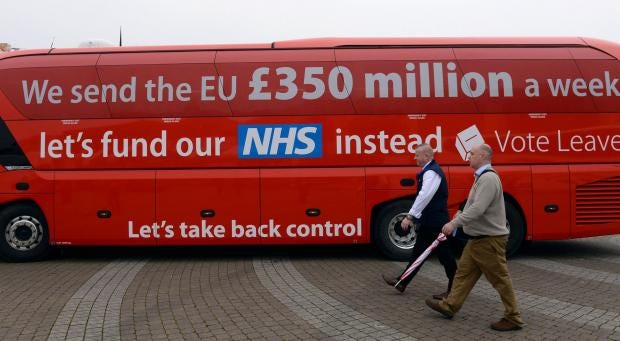
Take the Brexit bus.

Image result for brexit bus

Never was such a succinctly effective untruth so widely used, and accepted, to justify an argument. The other side of the coin, though, cannot be emblazoned on the side of the bus so successfully:

Related image

And herein is the underlying problem - the arguments for and against any subject generally have on one side an attractive soundbite that makes perfect sense to people who like their news in short paragraphs; whilst on the other, a complicated narrative with detailed explanations can confuse or bore the average reader. Guess which story is likely to garner the most supporters...

And that is the disadvantage of those who seek to explain the truth and justify their answers in more detail - they can easily be drowned out by heckling from the opposition, or mocked for their unwieldy explanations. Short, snazzy slogans are the domain of commercial retailers and sports teams, but the political classes are getting in on the act, and taking their ideologies, warped or not, to the wider public. Unfortunately, and I don't think I am going to gain many friends by writing this, but there is a large section of the population that is easily led by simplistic messages that claim to be able to improve their lives, the very basis of commercially successful strategy. Taking this out into the real world is both reckless and unfair. The truth becomes blurred by people wishing it true, no matter how false it is.

The BBC has recently set up a Permanent Reality Check team to look into stories and claims that have been flagged as containing an element of untruth or spin. As you will see from its detailed clarifications, the answers are more complicated than the text they were originally packaged in.

If we are ever going to break the cycle of untruth, we have to simplify the message of truth. how could Brexit have been prevented? Simple, positive messages showing the benefits of the EU would have garnered a lot more support than the Osborne-Cameron fear campaign. Take the Facebook group WhyEurope - they have been developing positive slogans in support of Europe for a while now, and many of them bring the positive side of the story into a far more easily comprehensible light:

"Europe because...
We all have better things to do than waiting at borders."

"Europe because...
You receive the same medical care abroad as at home."

"Europe because...
I don't want to pay custom fees on Amazon"

"Europe because...
it's like being rich - you have 28 different places to live."

"Europe is like a window...
Often invisible, but you're gonna miss it when it's broken."

If only this group could have got this type of message out before the Brexit referendum... But of course, these positive features do not ring with people who aren't as greatly affected by them as they are by more pressing needs, like their health, social security, employment and domestic lives. Which is why their disenfranchisement will lead them to seek scapegoats and form up behind a cheerleader who will promise them sunnier times ahead, even if that may clearly not be true.

Populism does not need to speak the truth; it needs to press the right buttons. Which is why Donald Trump and his team could think up non-events like the Bowling Green massacre that never was, and the much-derided Sweden incident. People want to believe in Area 51 cover-ups and refugee rape stories in Germany. They want to believe it so badly because they are desperate to be right for a change. They have spent decades being told they are at the back end of society, misfits, plebs, rabble, and now the Establishment is teetering on the brink of self-inflicted destruction, those who get out of bed early on the opposing side are seizing their chance.

The only way for the current political class to salvage this is to shine an equally positive light on the future rather than the incessant sad music being they play while forcing through austerity policies on the poorest of society. Governments insist there is no money for schools, public transport, healthcare, welfare and job creation, yet there is ample money for defence and meaningless vanity projects. The current batch of politicians like Schäuble, May, Juncker, Rajoy, Hollande and recently Renzi and Cameron, seem (or seemed) to be doing very little on the surface to quell the fears of the impending downfall of Western civilisation, just carrying on as normal while all around ordinary people are growing tired of hearing about the closure of hospitals here and the reduction in police there, while third countries that are not so friendly to the West are now so obviously trying to infiltrate the system by subterfuge. People are looking for a sign that everything is all right and these dark times will pass.

If the West is serious about keeping up its standards then it needs to find some visionaries and statesmen and women from somewhere. The space is full of politicians acting like glorified civil servants, more worried about their own opinion poll rating than doing what is needed to re-calibrate the situation; any shining lights are extinguished by being marginalised by power-hungry politicians or disillusioned by the rigidity and intransigence of the political system.

It's time someone with a positive vision and two very sharp elbows stepped up before the populists get there first.

Wednesday, 1 June 2016

Will Brexit bring about greater democracy and prosperity? Simple answer: no. More complicated answer: below


The first things all Brexiteers bang on about are:

1. The money the UK throws at the EU when it could give it to the NHS
2. The democratic deficit at the heart of the EU
3. Immigration issues
4. EU law and human rights
5. Corporate freedom
6. Independence
7. Because the UK is always isolated and never gets its own way

These are smokescreens for the the general consumption of those who like their news delivered in handy little soundbites that they can quote later to Bill down the pub. The real truth is somewhat greyer and a lot less savoury. As someone who lives and works on the inside, I would like to put the record straight on a few of these.

MONEY, FUNDING AND THE NHS
Firstly, let us consider a few things concerning the distribution of funds. The UK puts in a lot of money as it is one of the richest. It works a little like the tax system: the more money you make, the larger your contribution, so of course you are going to pay proportionally more than, say, Spain or Finland, but sizeably more than the Czech Republic or Slovenia. That is normal. Why are Brexiteers complaining about this? It seems they want to be clients, not team players. Where's the solidarity in that? And what the country gets in return is never discussed as it's not in their interests.

Yes, the EU can be a little profligate with the funds, but the fact is: agriculture, science and research, infrastructure, education and many other aspects of life would not receive the funding they need, and I include the NHS here, because I think herein lies the rub: the EU funds these things without subjectivity, based purely on need and the effect it will have on the improvement of people's lives.

Do you really think, deep in your heart of hearts, that the Conservative/Neoliberal alliance at the top of and above the UK government really cares about those things? I don't; I think it is another chance to grab more public money. Why waste it on schools when it could be invested in private enterprises and corporate landgrabs? 
At least, with the EU, those funds get to where they are supposed to. Take it away, and watch the NHS falling and being sold off, schools getting privatised, infrastructure budgets being cut, and farms being sold off to rich landowners who can turn them into supermarket-run agri-factories.
Do you trust the UK politicians to look after the NHS, farms and schools? Honestly???

DEMOCRACY
There is the supposed democratic deficit at the heart of the EU. Well, shall I tell you what a democratic deficit looks like? It looks like people who act in their own interests whether they are elected or not. Democratically-minded people do things in the public interest anyhow, whether elected or not. The expenses in the European Commission are incredibly stringently controlled by the Court of Auditors, and you will not see the civil servants being chauffeured about in black cars. You will, though, see the politicians (yes, those in the European Parliament too) being chauffeured about, because they are politicians and to leave them to public transport would be like asking a Yorkshire terrier to do your accounts.

But the Commission is pretty apolitical and works for the benefit of all, and despite its many foibles, is actually more on the side of the people than the politicians. There is a European Ombudsman that anyone can use to blow the whistle on improprieties; there is a European Consumer Rights and Law commissioner, who makes sure we get value for money, like reducing mobile phone tariffs across the EU; and there is a scheme whereby any EU citizen can go into the embassy of another EU country when abroad and get proper representation. But you don't hear about these things because it's not in the interest of the EU's detractors.
But it's a terrific trick of national governments that they get the Commission to do their dirty work, taking one for the team, time after time after time, so that they don't get blamed. The fact of the matter is, though, the 28 national leaders of each country, known as the Council of Ministers, sit down around the world's most expensive table to discuss what they wish the Commission to implement. So, the Commission is, in essence, just carrying out orders of national politicians. In the words of Sir Humphrey Appleby in Yes Prime Minister, "Almost all government policy is wrong... but frightfully well carried out."

IMMIGRATION
This is the scare story du jour. And it's a complete fallacy. Let's be honest, shall we? The country is not overcrowded; it is just underdeveloped and badly maintained. The infrastructure was built 150 to 200 years ago after the Industrial Revolution for the society then, and it has been slow to be updated. The roads in the UK are far narrower than in France or Germany, the houses smaller, the hospitals and airports built in far smaller plots. Look at Barajas Airport in Madrid - it is on a plot 5 times bigger than Heathrow. Charles De Gaulle, Frankfurt and such are massive in comparison. But the main issue is housing. It is not that there is no space; it is that the developers have artificially created a bubble by not building on the land they were designated, and so the demand sky-rockets and the prices go up. It is not in their interests to build because the prices will tumble and their profits too.
Furthermore, do you really think the country will sink into the mud because Poles, Lithuanians and Romanians, the large part of whom have a greater work ethic for less pay, are doing all the manual jobs? No. Because, sadly, Brits have become colonialists in their own country. Don't blame the new arrivals - blame mean-minded bosses for not being willing any more to pay full price for a proper day's work. Do you think this will clear up after Brexit? Do you think the gap will return and the market will be filled with British workers in the fields, on building sites and under the kitchen sinks? Rubbish. The market demand is insatiable and even if you started to train up locals now to take over, the full quotient would not be ready for employment for a good few years. And do you think prices and wages will remain the same? No. Because British people still expect a bargain, but workers will not accept the same payment rates as those who come to Britain for work out of necessity. What you will end up with is a skewed law where the cheapest will get all the work and hourly rates will fall everywhere in all sectors of work.

EU LAW AND HUMAN RIGHTS
It is claimed that too many people are abusing the EU's Human Rights legislation. Too many people are taking advantage of the current law to get out of prison or to get more benefit payments for themselves. This is not a falsehood, but it is an exaggeration. The UK government has suggested withdrawing from the ECHR (European Convention on Human Rights), drawn up by British lawyers after WW2, and implementing its own Bill of Rights. They can go ahead if they want, but the fact that all EU citizens are guaranteed the same rights is enshrined in EU law, meaning equal treatment for all.
Do you really think, Dear Reader, that the British government will make the situation better? I can answer that one now: of course not. If anything, it will make it easier to implement other laws that restrict the rights and freedoms of everyone in the land. I cannot imagine a more sinister power-grab than this. Imagine something simple as EU law concerning consumer rights: let us say you buy a kitchen and it is riddled with problems. EU consumer protection law dictates that the company has to either correct it or replace it without cost. The same goes for clothes, furniture, computers, everything. You have the right to return your goods to the shops within 14 days of purchase, all because of EU law. 

The four very elements that the Leave campaign is highlighting are the four very elements that everyone should be worried about. It is a myth that things will improve if the UK leaves - the EU guarantees so many more freedoms to its citizens:

  • The right to work in other EU countries without needing visas, residence permits or the filling of quotas
  • The right to study in another EU country for all or part of your university course (Erasmus)
  • The right to the same mobile phone roaming costs and no nasty bills no matter where you are in the EU
  • The right to the same standard of healthcare as back in your own country
  • The right to vote in local and European elections wherever you are
  • The right to live where you want and be treated by the local councils and national governments the same as locals
  • The right to the same consumer law as everywhere else
  • The right to jump on a train, plane, boat or bus to France, Belgium or wherever and not need to worry about declaring your alcohol or tobacco
  • The right to go from Lisbon to Warsaw without showing your passport
And many other things.

THE SILENT TAKEOVER
Just remember one thing: once the UK frees itself from the EU shackles (in other words from keeping it on the straight-and-narrow), there will be nobody else to keep an eye on the opportunism and impunity with which the corporate elite will act. This is your future. Nobody can tell you this because this is much more inflammatory than the stuff that the In and Out camps have been propagating thus far. The In campaign dare not say these things because some of them would be believed.

But the time is coming for you to make up your mind. Do you want to guarantee your own subjugation to a corporate elite? Do you want to hand over the things you most cherish about social democracy to faceless (and often heartless) drones in glass towers? Would you rather your tax money went to help the landed gentry to buy up the rest of the countryside and pay for their own limousines or would you rather your taxes guaranteed a harvest? Would you rather your money went to help poor people up the social ladder a little? Would you rather your taxes paid for infrastructure and education, whether here or in the EU at large?

I know where my allegiances lie - and leaving the largest trading bloc the world has ever known is not going to bring you prosperity. It will bring more prosperity to those who already have it, while turning the country into a feudal state.

INDEPENDENCE
Independence from what?
The UK is already independent. 
But I'll tell you what they want you to believe:
That outside the EU "we" will be able to make our own laws. What kind of laws? Do you think it will be for the benefit of UK citizens? I don't. It will be for the benefit of the One Per Cent.
Furthermore, we need to remember who we are and not who we were. We are members of a club of 28 nations, some of whom are "more European than others", so to say. It is time the UK started acting more European and stopped sniping from the sidelines. The EU is more heavily supported by smaller countries than larger ones, and the answer is simple: the President of the European Commission is Luxembourgish, the previous one Portuguese. the President of the European Council is Polish, the previous one Belgian. The thing is, it gives the chance for smaller countries to shine on the world stage like they would never be able to if they were independent. 

The larger countries of the south, like Spain and Italy, are also by-and-large pro-EU because they understand the prestige membership brings them. The prosperous and fiscally careful countries of the north and central areas, like Sweden, Denmark, Poland and the Czech Republic, are more sceptical because they also like their freedoms, but none of them would think leaving the EU would solve their problems. The largest countries, like France and Germany, have found it hardest to assimilate to the EU because they have needed to shrink, or at least take on fewer airs of a large country although this is of course very difficult, especially when it seems nobody else is on your side. Just ask Angela Merkel about refugees and the "solidarity" she received. 

Even Greece, the country with the biggest reason to be upset with the EU, does not want to leave. It might want to leave the Eurozone, but most definitely not the EU. So the UK is a little bit like Denmark, and a little bit like Germany. What it needs to do is just relax into its role as a counterbalance to the Eurozone's largest powers and stick up for those countries that wish to remain outside. It needs to engage more, be more understanding and empathetic, and stop thinking everyone should act like them.

Do you really think independence will guarantee self-control? I don't. I can't see how voting to leave a club but having nevertheless to pay membership fees to access it will really make the UK independent. The conditions would remain similar but the UK would not be permitted a say in any matters. Furthermore, it will take years to undo all that constitutional paperwork.

Which brings me on to...

HAVING A SAY IN EU AFFAIRS
The UK is alone and isolated in EU negotiations? Rubbish. The UK has had a great deal to say about the EU and its workings. 

  • For one thing, the UK was central in introducing the call for tender system known as TED to allow for a more simplified and equitable EU-wide system of provision of goods and services so any company anywhere can bid for a supply contract. 
  • The UK, as the largest non-Eurozone member state, is the de facto leader of the outside pack and recently negotiated more rights for those wishing not to join the Euro. 
  • The actual running of some of the EU institutions has in recent years become much more familiar to British civil servants than to French ones. The streamlining of administrative processes, the cutting of costs and bureaucracy, the accountability of every job posting, the justification of every business journey made, the pricing of every cup of coffee poured in an EU building... everything in the EU institutions is accounted for, down to the limitation of photocopies for language trainers. 
  • Furthermore, English is the prevalent language these days, and French is now a more and more distant second. German is waiting in the wings to be promoted if the UK leaves the EU. And English will, in one night, become obsolete as the Lingua Franca of the EU. It will lose its status as the working language of the EU institutions, and French, German and probably Polish or Spanish will get a much bigger role to play in the EU.
  • There are disproportionately more British (and Irish) staff in managerial positions than other nationalities, although due to the geographical position of the EU institutions, French and Belgians make up a large part of the admin staff. In the Court of Auditors, English is the only language and to get a job there it is essential to speak it to a level good enough to work in.
  • In negotiations, the only reason why it seems the UK is isolated is because the UK government really does not get the EU. It acts like a yob in Torremolinos, wanting all the home comforts but without the disadvantages. It was shocking and shameful for me to see my government try to negotiate favourable treatment in the EU and at the same time refuse to play any single part in the Syrian refugee crisis. 

If you really think the UK is hard-done-by it is all smoke and mirrors. The government just needs to stop moaning and get on with teamwork. If you think the EU is a gravy train, try speaking to assistants and administrators in Luxembourg at the bottom of the EU pyramid, where they earn less per month than local bus drivers, gardeners and cleaners. This is because staff in all EU institutions in all cities earn the same, calculated on Brussels salaries.

Finally, the EU is incredibly bad at promoting itself, which is both a good and a bad thing. On one hand, it means it is too busy doing what it is supposed to be doing rather than spending time and money advertising itself - the quiet ones are those who are getting on with the job rather than looking for reward. At the same time, it means people are malinformed and misinformed about the good it does. 

Get informed before you decide.

Sunday, 20 December 2015

A Goslitski family centenary of immigration

This week is the anniversary of a momentous occasion, although it will go almost unnoticed. And that is probably the most fitting way to spend it. On 22nd December 1915, my grandfather planted his tree in the British orchard, paving the way for the fledgling Goslitski family to thrive. It is the beginning of a very successful immigration story.


Above is the registration certificate of my grandfather, Eugene Alexander Goslitski, a Russian national of Polish descent, who came on his own looking for a better life. I have done some research into his background and reasons for leaving, and there is not much to go on, but we should look at the facts: Poland had not existed since 1795, and its lands had been divided up by Prussia, Russia and the Austro-Hungarian Empire. My grandfather was a Russian simply because of where he was born. Poles in Russia were treated as outsiders and were not full citizens. Many of them were deported to Siberian camps for katorga, that is exile and hard labour in underpopulated areas where nobody else was available. Several people with my family name were registered in those camps, although it is still not easy to identify their connection to us.

Whoever they were, my family name is quite unique and if you have that name you can only be from that family. The internet has become a sort of calling card for me. Many times, when I don't have a business card on me, I just tell people to Google me, because I'm so easy to find. This is both a blessing and a burden. For that reason, anyone with our name mast be related to us. We are like Grimaldi, Habsburg or Rothschild, although much less illustrious. I say this because our family name is aristocratic and my grandfather spoke about it now and again. He would often tell his daughters that back in the home land they were princesses. This was an elaboration - countesses would have been closer to the mark, despite their stark diminution under occupation, where all Polish aristocrats underwent screening for Russian ancestry, and those without were removed from their titles. 

It is quite likely that my grandfather left because he had no life, no opportunities and very little to keep him there. He joined the Merchant Navy and sailed around the world before settling in London, where he arrived in the middle of the First World War. This was quite remarkable, because with the war in full operation, every man was needed on the battlefield or on the sea. But come he did, and he died in the Brook Hospital in Greenwich on 22nd November 1960. 

During his life, he was a marine engineer, and he worked on the other side of the River Thames from his home in Bermondsey, less than a three-iron shot from Tower Bridge and the City of London. For that reason, he made a great deal of effort for the cause during the Second World War, and was involved in the D-Day landings. My father told me he left for several weeks around that time and when he returned he was covered from head to toe in soot. He had been jumping from ship to ship maintaining and repairing the boats to get them to the other side. He slept for a very long time when he returned home.

He is one of many who were never granted full British citizenship, mainly, probably, due to that one word: "Russian". Britain and Russia were never the best of friends once the Tsar fell, despite being the first country in the world to officially recognise the Soviet Union. But without bilateral treaties, even with countries in the direct neighbourhood, every foreigner had to fulfil a certain duty to remain in the UK. My grandfather had to leave the country for 24 hours every year, and reapply for entry upon return. He didn't go to another country - he took the opportunity to go into the Thames Estuary on one of his friends' boats and get slammed for a couple of days.

And here is the main point: my grandfather, along with hundreds of thousands of deracinated people, have found new homes in their destination countries. The vast majority of immigrants and their children have contributed to society in ways that are often under-appreciated by people. Lots of them have become famous names (Sigmund Freud, Sir Alec Issigonis, Zaha Hadid, Anish Kapoor), and some have even risen to lead their country (Nicolas Sarkozy, Benjamin Disraeli). Immigration is good for any country - being a popular destination for immigrants is the best endorsement any country can have. It is a sign that newcomers can fit in, that the local population there is not bothered by change and people are considered people, no matter their origins. My grandfather, a larger-than-life character, was known locally as the Duke of Bermondsey. He made the most of his adopted country, and said it was the greatest nation on Earth. Immodestly, I cannot disagree with him. 

My grandfather left his home to seek new climes. He was an international man in a local setting. He had bigger ambitions for himself and he set off to better himself. If he had stayed there in Poland, he would have experienced two World Wars, numerous invasions and would have been witness to the horrors of the Holocaust and the next Soviet occupation, leading to the People's Republic of Poland. Instead, he took the chance to find a place he and his future family could thrive.

Immigrants have one thing in common: their entrepreneurial spirit. They know how to get on in life wherever they go. They will never be the same again once they do, because once you leave, you can go back, but you can never go back home. You are seen as a foreigner in both places. But in general, there is no reason why being a foreigner should make you a stranger. And the fact of the matter remains, the children of those immigrants will most surely never be seen as foreigners. In a country like the United Kingdom, we don't really talk about foreigners, only when referring to those who have still stubbornly kept up their stereotypical façades. It is very wrong to say that people should speak the local language at home or adopt every local custom. That is too much to ask, and is totally unfair. They should keep their own home fires burning - I do. I mean the ones that refuse to do any integration at all. The ones that have little or no desire to accept local customs, who never take part in local events, who do not learn the language and who keep unswervingly to their own traditions. 

As I said, being popular with immigrants is a good thing for any country, as it means the conditions are right. In the current crisis sweeping Europe, it is no wonder that so many of those refugees want to go to countries known for their tolerant attitudes to newcomers. If I were one of them right now, there are countries in Europe I would really not want to settle in. I wish some of the cynics would stop peddling the "benefits" myth. Of course I'd want good conditions for my family if I were an immigrant or refugee. Why would I say to my family, "lets go to Poldakia or Molvenia because if we can avoid being beaten by the police and rejected by the authorities, we stand a chance of getting our own room above an abattoir"? I would not. I would want to go to a country that made me feel welcome. The fact they provide me with food, money and shelter is another sign that they want me not to have to struggle with poverty upon my arrival. How horrible would it be if people arriving from war-torn countries were made to fend for themselves from day one? It would say more about us than about them, that's for sure.

Yesterday, I had the privilege of spending some time with some of the younger Syrian refugees in Saarburg at an art session at the cultural centre. They were making clay winter- or Christmas-themed figurines. I really liked their imagination. Below are some of their works. All of them, despite their torturous recent experiences, had made it to a place of safety and were adapting quite well to local life. Some were already speaking reasonable German. They all seemed well-adjusted and acted very maturely. I have a deep respect for anyone who undergoes such a harrowing journey to look for calm in their lives. Some of them will one day go back to rebuild their country, but many will stay, and having met some of them, I can safely say they will be a credit to their new society. My grandfather's life was not half as bad as theirs was back in Syria, which is why to deny them the chance of a new life and happiness is to betray everything my grandfather ever did.

Here's to another hundred years of migration!


Thursday, 10 September 2015

So, what are we going to do about the refugee crisis?


It is Europe's fault. As clear as crystal, it is our fault. When Africa and the Middle East were decolonised back in the post-war period, many previous occupiers just upped sticks and moved back to their capitals, leaving those behind to fend for themselves. They did not leave sufficient depth in the remnant institutions for those countries to maintain the relative peace and unity of the colonial days. Let us be honest here, what I mean is people did not fight each other under occupation as they had their foreign lords and masters as a common enemy. British colonies faired the best, with the majority of them being bequeathed the institutions and laws which have turned them into fairly successful countries in their own ways (barring a few abysmal failures), but it does not mean at all that they are exonerated. Most colonisers more or less lowered their flags, played the bugle and scuttled off home again, the only real leftovers being the languages inherited from their previous overseers.

The West's guilt
What these powers also did was divide up the Middle East and Africa in such a way that there were no real ethnic or religious boundaries, and for a reason: the French and British were worried about Arab unity. If the Arabs were able to unite under only a few leaders, they might become powerful and ultimately dangerous to European dominance. Look at India today. The Sykes-Picot deal made the area so unrealistically divided, bringing in kings, sheiks, presidents and dictators to rule the area, often being replaced when they had outrun their use, that it would keep them busily at each other's throats for decades to come. They needn't have worried so much - sectarian skirmishes and various long-lived grudges didn't take long to appear. And so the plan worked enormously well. Even when the region tried to unite under the umbrella of the United Arab Republic, a kind of EU-prototype conjoining of Ba'athist regional powers Syria and Egypt, it did not last long when one of the two member states underwent a coup d'état. Iraq was also hoping to join this group, and if it had, the momentum may have swung other regional powers behind the union, so chances are high the Syrian coup d'état was the brainchild of someone sitting uneasily in the Elysée Palace or Number 10, who did not want a successful Arab bloc at the end of the Mediterranean.

So it was all going to plan for the former colonial powers until the 1980s, when dictators like Saddam Hussein and Colonel Gaddafi started to get too big for their boots, wanting more firepower and weaponry to inflict the latest atrocity on their huddled masses and threatening the West with all sorts of vengeful actions. The Lockerbie disaster and the invasion of Kuwait were two of those actions. I remember, during the retaking of Kuwait by the West and the Allies' subsequent march into Iraq, they didn't finish the job off. They didn't remove Saddam from power. That may be because American intelligence under Bush Senior knew that Saddam Hussein was still the right man for the job in Iraq. He was holding the various loose pieces of fabric together and keeping a firm lid on any uprisings. This was perhaps the smartest move of the last hundred years. The smartest move of a lot of very reckless ones, but a smart one nonetheless.

The most reckless action of the last thousand years (or more) took place on the watch of America's most undeserving president, George W. Bush, and Britain's messianic Prime Minister, Tony Blair. Under the pretext of weapons of mass destruction, and in the aftermath of the semi-apocalyptic destruction of two towers in New York by an extraordinarily wily and ostentatiously rich Arab psychopath with a bone to pick, these two decided to send in the heavies to "clear up" the Middle East. Now... although a lot of us were fooled by the idea that Saddam was an awful dictator who needed removing before he murdered all the minorities, we did not expect that Bush and Blair would totally fudge the entire change of regime. If they really wanted to bring in democracy, they had to realise what they were letting go of. Decades of relative calm held in place by the threat of brutal retaliation by the leader, the sectarian powder keg that was Mesopotamia was firmly sealed by Saddam Hussein, and his removal was going to open it all up.

Reasons for leaving
And it did. But not only that, it brought out all the other dissatisfied wretches and rejects from every other part of the world. It gave the Jihadis a place to really get their act together and begin the reconquering of the world. The Jihadis of Islamic State are not there to just retake what territory they lost, they are there to humiliate and ultimately bring down the governments of the West. And where better to start than right on their doorsteps? The twisted ideology, self-publicity and money-raising capabilities of these warmongers are nothing short of genial. Recruiting the frustrated, the lonely, the talented oddballs, the pious and the rejected, they tell their targets about the wonderful life they could have in the new Islamic State. They tell about the feeling of superiority these outcasts will have, and the responsibilities they will be given.

Imagine being given the power of life and death over whole towns. Imagine a country like Syria, which despite the brutal dictator, had a pretty good quality of life and a high standard of education, falling apart due to sponsored destabilisation by rich madmen and other regional rivals, and then taken over by the worst kind of warrior. Let us not forget, despite the atrocities carried out by the previous regimes in Iraq, Syria and Libya and all the other dictatorships in the region, if not the world, most people still stayed in the area, even if it was under threat of gassing or midnight removals. Nothing as brutal, savage and inhuman as Islamic State ever happened under the other dictators that caused such mass panic and the fleeing of hundreds of thousands of people to Europe. Imagine, having been a well-to-do middle-class Syrian five years ago, being told your mother has been tortured, your wife abducted, your daughter gang-raped and your son executed. Imagine being the neighbour of that family, as yet unscathed. Wouldn't you pack up and get out of there as quickly as you could? Wouldn't you, right now, be either on a Greek island, at Keleti railway station in Budapest, or scrambling over the Austrian border on your way to a place where you would be given a bed, some food and a new life?

What is worse, we in the West sold the previous incumbents the hardware to be able to carry out these crimes on their people - or at least we sold the hardware to the side our governments supported at the time. Not only the West - Russia and China are most probably in it up to their midriffs too. So when the little guys started fighting back, our governments chose a side and supplied more weapons to them. It was not uncommon for them to change sides, depending what they could get out of it all - fuel, minerals, lucrative contracts - nothing was governed by principles of fairness or justice. The Taliban was, at one time, an ally. There are many reasons why we in the West are now reaping what we sowed, and this is the final repayment of the Karma debt: what we failed to do back then to alleviate their transition to independence and the subsequent brutalities which led to the necessary intervention of the West (again) have led us so far that we have unwittingly created the diabolical cults of Jihadism and Islamist violence. This is the result of our short-termism and complacency.

Blood on our hands
And this has been the case from Eritrea to Erbil, Somalia to San'a, Palestine to Peshawar and Casablanca to Kandahar. We are guilty of great human suffering, even if by proxy, even if 50 years may have passed since we lowered our flags. What we should have done at the end of our empires was to integrate those countries into the world economy by setting up trade talks with international organisations. We should have split the countries up more logically rather than flippantly drawing ridiculous borders after liquid lunches which ended up with names like Winston's Hiccup. We should have let them form their own alliances and not stepped in when things got a little tricky. If we wanted to keep them busy, we should have made it clear from the start that we wanted to be their commercial sponsors and patrons and given them skills and trades. We should not have just let them get angry about everything. And don't get me started on Israel. Good idea in theory, but in practice, we should have been more insistent about Palestine and guarding the inhabitants who were already there. And the playing of the anti-Semitism card, getting easily offended by sometimes very trivial things like the recent palaver over the water showers at Auschwitz every time something does not go their way is wearing very thin.

So all these power-flaunting irritations of varying sizes have morphed into a giant middle finger to the Arab world. And in turn, as we have the stability and the power, we are both their enemy and their role model. Their bully and their refuge. Their bomber and their saviour. It is a strange situation to be in. And right now, having invaded Libya on a whim, having deposed Saddam in a little over a fortnight, having spent years in Afghanistan, having overpowered so many brutal dictators, we get cold feet at the very moment when we actually should do something about it. We are creating haters here in Europe due to our lack of a clear strategy and making it seem like our governments don't care. But there is a clear strategy: Russia is a very powerful player in Assad's Syria. The Russians have a fleet based on the Syrian coast courtesy of Assad. Recent pictures show that area to be totally at ease and peaceful. I am quite sure the West had been waiting for IS to overrun Assad all the way to the coast, therefore forcing Russia out of the picture, before stepping in, but now that looks unlikely. So there have been rumblings in France and Britain about sending in more military firepower. The West's distaste in confronting Russia is at least a sign it has thought about a strategy, even though it seems very likely Assad is now entrenched. The optimistic, dare I say unrealistic, plan to force Assad out through a six-month "transition period" is post-colonialist daydreaming, to say the least.

Misleading facts and figures
This is the fact about the Syrian refugee crisis: there were about 20 million people living in Syria before the troubles. Over half of them, about 12 million, have in some form or another been displaced. The vast majority of those, about 8 million, have fled to safer parts of Syria and about 4 million to neighbouring countries like Lebanon and Jordan. Only 250,000 have tried to get into the EU, but more are coming all the time. There are also great numbers of people coming from Afghanistan, Eritrea and Sub-Saharan Africa. The number of people displaced is an appalling humanitarian catastrophe and a very dark period in our history. The total number of people trying to reach European shores is unknown, but they are coming for a reason.

And here is where we need to take an honest step back: not everyone coming to Europe is doing it because their lives are threatened. Many are coming for economic purposes. There are also a number of rumours that are sweeping conspiracy theorist websites everywhere: that there are lots of Jihadists in amongst them, especially since IS warned they would send hundreds of thousands of "soldiers" to Europe back in February. The theories are not stupid and it is not wrong to be worried about this being the case. It is entirely feasible. Think about it: if the price of transport to Kos, Pantelleria or Sicily costs between one year's salary and five years' salary for one of those refugees, imagine how much a family would have to pay to get across the sea. Who is paying for them? The theory goes that some rich Sheiks are paying the traffickers to send hundreds of thousands of Muslims to Europe to dilute the secular population and flood Europe with Muslims. Again, another plausible theory, but not one I have yet chosen to believe.

Right-wing threat
What seems to be threatening to occur now, unless more people are mobilised to intervene and prevent civil unrest, is the following: the Hungarians and the British, with their fence-building and detaining of refugees at Röszke and Calais for no good reason, are no better than each other, and are giving Europe a bad name amongst those fleeing violence. Intimidation, corralling, delaying the process of registration and integration, these are all making new enemies of Europe. Showing pictures of rubbish strewn on footpaths as if it's something new; people rushing police;  people being tripped up in order to get a shot of an angry Arab; these all add to the fuel of hatred being spewed by Europe's many right-wing leaders, like Nigel Farage, Filip de Winter, Marine Le Pen, and Viktor Orban. If we don't properly welcome these moderate, fairly secular Syrians arriving at our frontiers, we risk embittering already desperate people who just want peace.

Furthermore, we seem to have let the right-wing media and politicians tell us these people are just troublemakers in disguise. I have a different theory. These are very, very different people indeed. I know lots of north Africans and Middle-Eastern people from my time living in Belgium. I also know many from when I was in London. They fall mainly into two categories: very well brought up, courteous, thankful, respectful, fully integrated and well-grounded (often much more so than their autochthonous European counterparts); or frustrated, lonely, badly-integrated, vulnerable, impressionable and looking around for a friend. And it is these people who need saving. It is indeed these people that I can relate to and identify, because a similar thing happened to me, although not in a religious context, I hasten to add. If I had been promised friendship, camaraderie and support, I would have given the same back. If I had been told angry stories of mistreatment and insult, I would maybe have wanted revenge for my new friends. It is a very easy hole to fall into, and understanding that these new arrivals are more like us on a human level than we have been led to believe is one thing that scares the right-wing media. So what we need to do is welcome these people immediately, and fast-track them into work and an autonomous life so that they feel part of us as soon as possible. They are, after all, smartphone-using, mostly well-educated, well-behaved people who, like their counterparts of 70 years ago, are looking to escape persecution.

There is hope
And that seems to be happening. Angela Merkel, at least, has played a significant role in alleviating the impact of so many arrivals by firstly spreading the word that people must be tolerant, helpful and welcoming, causing the refugees to make Germany their top destination. And this is currently the case. It is gratifying to see that the German government is making a real effort and taking the lead in showing respect, trust, and a level of humanity these arrivals have not experienced. Many of these people will never go home again. But once the war is over and the cancer of terrorism has been purged, some may choose to return to their ancestral lands. But first, it is necessary to clear the place up.

How? How do you deal with the embodiment of evil that is Islamic State, and how do you persuade people to return to places that have seen such grotesque acts of barbarity and especially to move back into properties that were usurped by other people in the meantime? There is a precedent for this, and that is the Second World War. All sorts of people who were displaced by it, whether Poles, Jews, Belgians, Russians or Germans, the bombs rained down, the mass executions took place, the persecutions carried on, the atrocities widespread. There are still scars of history in places that will forever keep their air of sadness: Auschwitz, Theresienstadt, parts of Warsaw, Bergen-Belsen, Katyn or Dresden in the Second World War are some of those places. In more recent times we can look to Srebrenica, Kigali or the World Trade Centre. All have been places of the most atrocious of crimes, resulting in the needless deaths of hundreds of thousands of people, and despite the abominations that took place there, people have still returned, even if many wounds have yet to heal.

I do believe that once the Jihadis of Islamic State and other nefarious organisations have been eradicated, people will once again return to their lands. Not all, but many. In the meantime, the West had better start dropping its proclivities of setting up puppet democracies and learn to tolerate the relative safety and calm brought about by strong dictators. It had also better give the various ethnic groups the chance to run their own lands, not least the Kurds. The Turks will protest long and hard, but the Kurds need to be treated as equals. Once all of these things have been achieved, it is time the West grew up and left that area to deal with itself.

Sunday, 3 May 2015

Why the electoral system in Britain is broken and how to fix it

In the beginning, the Labour Party went barking mad. Then the Conservatives got sleazy. One party in power alone, and the dangerous ideology that it implements, has caused untold damage to the nation, and now many people are reluctant to allow either of them to govern alone. Where do we go next?

The Labour Party of the sixties and seventies was full of paranoid militants and fist-pumping demagogues that were able, at the drop of a foreman's hat, to hold the country to ransom with one-out-all-out strikes and hard-cheese speeches if they didn't get their way. People saw through it all and Margaret Thatcher's Conservative Party won by a thumping landslide. Even my left-leaning father voted Tory in 1979. Due to their utter profligacy, Labour had left the country in a serious financial crisis. They were also being held to ransom by firebrand union members who had seen to it that the electric regularly went off and the shops weren't fully supplied if they didn't get their way. With Labour unelectable, the Tories just ran roughshod over those they could bully and cajole (the unions, Northerners, Scots and the poor among others) and alienated whole swaths of the electorate that they didn't care about. Sometimes this was for the good of the nation (hence the swift but ruthless reduction in the national debt) but often the upshot was the sale of another government enterprise for a fraction of its asking price to a friend of a friend of the minister responsible, who also got a cut somewhere along the line.

The swivel-eyed lunacy of the left kept them out of power for 18 years, until the back-stabbing sleaze of the Major administration made Labour understand that by rebranding itself, it could win once more. Tony Blair realised socialism was a dirty word, but people wanted to throw out the Tories, and they voted for New Labour in their droves. Sworn capitalists, bankers, even right-leaning newspapers gave their blessing to the new set-up. The country went into a deep euphoric trance brought on by spin doctors' magic touches and Tony Blair's messianic speeches, which made the nation realise that at last they had a leader they could say was punching above the country's weight abroad and redressing the balance at home. The trance was so deep, Blair even got re-elected despite a highly unpopular war in the Middle East.

...However...

...However...

What we didn't realise, on that day when Blair gave up Number 10 saying, "it is over, goodbye," was that he had handed over the keys to the nation to Gordon Brown on the eve of a financial meltdown and a global recession that would have far-reaching consequences for some time to come, probably a generation. It didn't have to be like that. Other countries, like Canada, Germany and Australia, avoided it. He was, quite frankly, spending his way into people's affection. Buying popularity. The most narcissistic and deluded Prime Minister of a Western democracy there has ever been decided to bail out when the money dried up. Nice.

And in stepped Gordon Brown, the last Prime Minister of a one-party government we will have for a very long time. It wasn't his fault. This was Blair's ultimate revenge for his great rival: leave him to pick up the pieces; let him take the hit. And so he did. Officially voted the single-worst PM in living memory (after Callaghan and Heath that's quite some doing), Brown made sure Labour was to lose the 2010 election by being indecisive, dithering and looking gloomy even when he was smiling. He had no real policies, just improvised "ideas" from the many think tanks New Labour employed at the taxpayer's expense.

And finally in May 2010 the electorate decided there was another way. Out went old confrontational politics, in came consensual politics. The Con-LibDem coalition that formed held together pretty well for the full 5 years, and I think, according to the polls, David Cameron and his two-party government didn't do badly, getting the UK out of some pretty tricky situations. But during the last 5 years, several things happened that have transformed the landscape of UK politics forever:

a. the Scottish referendum mobilised a whole nation, and despite the failure to secure their own nation state, the SNP is poised to win nearly all the seats in Scotland. Labour made themselves toxic in the country by siding with the hated Tories in the referendum debate. I fail to grasp why the Scots should think this, because it's only on this one opinion, which was demonstrated by all the parties except the Greens. I'm sure Labour and the Tories think trees are green and the sun is bright: it doesn't mean you have to hate one party because they agree with your enemy.

b. This has caused other parties to seize their moment. Plaid Cymru in Wales, the Greens in England and UKIP have cajoled their way into mainstream politics to such an extent, that they found themselves sharing a stage with the Big Three (well, the Big Two and the little coalition partner) during the recent leaders' debates. The smaller parties proved themselves worthy of being there too. To such an extent, in fact, that in some polls even the Greens are ahead of the Lib Dems.

c. Labour and the Lib Dems have lost credibility - the former due to Scotland and the last time they were in power, the latter over broken promises to cancel tuition fees. This has let the others in. The majority of party swingers are Lib Dems to the Tories or UKIP and Labour voters to the SNP, Plaid Cymru or UKIP.

The problem now is that the parties and their leaders really don't have a clue how to operate in these new conditions. Miliband and Cameron are refusing to talk about the deals they would do with any coalition partners; Miliband has said emphatically that he would rather the Tories got back in than be part of an SNP-Labour coalition in any shape or form. How many of us really believe that? He was stupid to say it, because he will be held accountable after Thursday, if the mathematics mean it is the only option. Cameron is tight-lipped about his party's future, just like Miliband, and dodges any question about coalition. These two are the living embodiment of a country experiencing the death throes of two-party politics. People's allegiances have changed, much like their shopping habits. No longer do we go to the same shop for the product we want; we look around for a better deal, and at the moment, we think the better deal is a combination of parties, to keep checks on the bigger ones.

What is likely to happen after 7th May is anyone's guess, but I would hope that whoever is there will be grown-up enough to fix the electoral system. These are two scenarios:

1. All parties' leaders choose their brightest minds who are to remain impartial and non-partisan, to discuss how to implement a better and more representative chamber, maybe where you get the same percentage of MPs as the electorate voted for you. It is ludicrous that the Greens, if they get 7% of the votes, might still only get one MP.

Problem: although the Lib Dems, UKIP, Plaid Cymru and the Greens would benefit from this, the SNP, Tories and Labour, crucially the three biggest parties, would not. A fudge would most certainly happen that would please nobody and further alienate an already tetchy electorate.

2. I would favour keeping the constituencies but having a two-round election, where the two candidates in a constituency with the most votes would go through to a second round the week after, thus guaranteeing MPs garnered more than 50% of the votes in their chosen constituencies, but keeping them on their very best behaviour as they may very well not make it to (or through) the second round. This way, we keep the tried-and-tested constituency set-up, which assures MPs remain attached to their electorate, and at the same time ward off that most undemocratic and elitist list system favoured by some countries that should know better. Although proportional representation assures correct apportioning of seats, it distances party grandees from their voters as they know they're top of the lists and thus don't need to do any campaigning at all. They can just hire some party stooges to hand out balloons to passers-by at supermarket car parks. So I would be loath to unleash such a badly thought-out system on such an engaged and active electorate.

Problem: I can already see most politicians being fervent opponents, as this system means their electorate, instead of voting for whom they want, would possibly vote for the other candidate in a sort of "anyone but that lot" exercise. Tactical voting on a whole new level. However, if an incumbent MP has done a good job, most people would put party politics aside and vote with their heads. I know Tory supporters who vote for their current Lib Dem MP because he's been very good for their town.

Considering the looming hung parliament and the unfathomable mathematical hangover it is likely to create, it would not surprise me if the Tories and Labour went into some kind of German-style Grand Coalition just to keep their two wannabe sister parties, UKIP and the SNP respectively, out of government. I doubt it, but it is an interesting scenario. Could you imagine the stunned looks on the faces of the ruling coalition backbenchers, when some wealthy, landed Eton/Oxbridge alumnus with no chin and an accent that could cut glass is reluctantly siding with a tieless, comprehensive school-leaver wielding a thick regional brogue and bus driving and a stint at a supermarket checkout featuring heavily on his CV? Angus Robertson of the SNP would be the Leader of the Opposition. It wouldn't last long... but long enough to cause Scotland to chip itself off. Who outside Scotland remembers The Vow any longer?

Lastly, if big-party politicians want any credibility, they need to stop treating the electorate as idiots. If they are to do deals with other parties, they need to say so, so that the electorate can make up its mind better. This whole campaign has been about nothing but ignoring the vast elephant in the room that is the next coalition. I, for one, am not scared of the SNP; far from it. Considering the efficiency and straighforwardness of the Scottish government, I think the Westminster parties are scared the SNP will come in and sweep up too many of the little comforts the established parties took for granted. Complacency has no place in British politics any more, and I think a dose of SNP in government will do the country good. Leave the SNP out, and they risk Scotland breaking off altogether.