Showing posts with label Daily Mail. Show all posts

Tuesday, 18 September 2018

Imagine if Leave lost and we imposed a hard Remain - there would be anarchy

Let me take you back two years and three months to the time immediately before the Brexit referendum. The Leave campaign promised we would remain in the Single Market and Customs Union for the sake of business. Things would more or less remain the same. The Brexit deal would be signed and sealed in one afternoon. There would be more money for schools and hospitals, and the mainland would still be there to carry on visiting and trading with.

Fast-forward those twenty-six months, and now those same people are putting severe pressure on the PM to leave everything, which will most probably cause us to become more of a vassal state to the US than we ever were to the EU. They harp on about the "will of the people" and "they've had their say, there should be no more Brexit referenda," conveniently forgetting that the reason we have elections every couple of years or so is precisely to reflect the mood of the people at that time.

So let's see what life would be like if the tables were turned and the British government implemented a hard Remain...

It's the twenty-fourth of June in the Year of Our Lord, two thousand and sixteen. The people have spoken and it's a resounding victory for Remain. 52% of the electorate, a sizeable and clear majority [not, obviously!], have voted to remain in the EU.

David Cameron is delighted, and begins immediate negotiations to take the UK into Schengen and the Eurozone. By 2020, the British Pound will be obsolete, and the only monarchy in the Commonwealth where the Queen's head doesn't appear on the currency will be her own.

The gutter press, though, protests. "DON'T TAKE US INTO THE EURO", clamours the Daily Mail. The Guardian shoots back with images of Leavers including Michael Gove and Jacob Rees-Mogg under the headline "ENEMIES OF THE PEOPLE" for pleading with the PM not to join the Euro.

Remainers take to the readers' comments sections to have a good old-fashioned pitchfork and fire-on-a-stick fight over the direction of the country. They want Boris ostracised and EU flags to replace the Union Jack everywhere except on government buildings.

People like that Wetherspoon's guy and that Dyson fellow are routinely attacked on social media by hordes of Remainers, branding them all kinds of nasty names. Audiences on the BBC's political panel shows like Question Time constantly heckle the few famous guests who still dare to say they are Leavers. Katie Hopkins leaves the country to go and live in Alabama [in the end, there are pros to everything] and receives a slap on the face by several Remainers who showed up to the airport to make sure she left.

Those on the Leave side continue to campaign, saying the vote was close and there should be some compromise, rather than this total sell-out to the EU. Remainers heckle them, especially on social media saying "we won, you lost, get over it", and other cheap slogans to that effect. Leavers say "but we were told if Remain won, we would just carry on as normal, not join the euro and Schengen. We've been lied to!" Remainers say, "we knew what we were voting for", as if that was their original intention. Despite all the archived articles in newspapers and on TV, Remainers insist that was the plan all along.

Of course, this is never going to happen. Why not? Because those on the Remain side are far less vitriolic, caustic, venomous, spiteful, malicious, whatever your description, than a lot of those on the Leave side. Why so? Because, having been a member of a very large social media group actively trying to counter Brexit, I have noticed one thing: all 60,000 members are civil, decent and friendly. And being too "nice" may actually be their weakness.

It is absurd to think that the Remain half of the country would act in this way. Which is why I question a lot of the vitriol on the Leave side. It is astounding how much hate has built up when reading readers' replies in the Daily Mail and the Express. Where does all that aggression come from?

I think it stems from many different places:

  • Many people don't know why the UK gives money to the EU and think it's a waste. 
What they don't realise is that that money is 1% of every country's national spending, and a lot of it is spent doing local projects. The UK, having nine of the most deprived areas in the EU, the money gets re-invested in areas which the UK government would not consider touching.
  • A great number of people are conned daily into believing they are being ruled by Brussels. 
This is an absurd notion, but one that has a lot of support from the newspapers. Many newspaper owners, living overseas or in tax havens, have alternative agendas and don't like the idea that the EU is interfering in their tax affairs, so they cook up all types of stories and twist reality to make it seem like the EU is a left-wing dictatorship. They have been doing this for years. The link to the left here highlights the abominable abuse levelled at Brussels for the last 30-odd years.
  • Too many people found themselves excluded from the benefits of economic development
Successive British governments have done little to improve the lives of a lot of people in poor areas, and more and more people have slipped below the poverty line without having been given the chance to improve and develop. Wages have declined, prices have risen, working conditions have stagnated or receded, property prices have become prohibitively expensive, and healthy food like fruit or meat is a luxury. A lot of these people voted to leave the EU to give the government a kick where it hurts, but in fact, they have hurt themselves the most.
  • Apathy and ignorance
A great deal of the public have entered a kind of limbo world where they are happy with their lot in life (modest living, decent social life, car, a couple of holidays, maybe kids). Things like Brexit are at best a distraction, at worst an annoyance. They maybe voted in the referendum, but did so based on the last story they read and whether it was positive or negative. They don't really care either way because they only go abroad for a couple of weeks a year, don't need EU funding, and have routines that don't matter whether they care about the EU or not. When the Lambrusco price goes up a quarter, they might start wishing they had paid attention over the last 3 years.


What to do about this?
Recently, one member said he thought we should "start getting a bit French about the whole thing", which is not a bad description of where we are today: just half a year away from B-Day, and a whole raft of warnings concerning the UK's preparedness for the eventuality of no deal should be bringing the good people of Britain out on to the streets, but they are a sedate, passive kind of folk; that's why successive governments have been able to make them swallow all kinds of bad measures à la boiling frog.

Getting a bit more active in the streets, more frequently and more aggressively, would be quite a feat for the people of Britain to carry out. There are two reasons for this: firstly, most demonstrations take place on weekends unless they're strikes, because they are busy at work, and because of the British propensity to associate leave from work with bad performance, any time off is precious. Secondly, most British people don't really care enough to be out every day on the streets protesting, as they have jobs and livelihoods that are indispensable to them and they prize their private life more than they care about which people govern them.

In countries like Romania, where there have been great upheavals in recent times, whole swathes of people have been out on the streets for days, sometimes weeks, on end. The constitutional and democratic state of the country there is fragile and still in its infancy compared to that of the UK, whose institutions go back centuries. For that reason, British people still trust in the procedures and processes that flag up threats to democracy. But considering the fraudulent manner by which the Leave campaign won the 2016 referendum, all the evidence against them, and the reams of papers proving collusion with foreign hostile forces, the clamour to bring the perpetrators to justice, let alone annul the result, is unsettlingly quiet.

Why is nobody on the streets? Why are people not angry? Why does it seem that the press is more concerned with Jeremy Corbyn's views on Israel and Palestine than the crooks who are trying to take over the country by stealth? Smoke and mirrors, it seems. Keep the spotlight off the bad news of Brexit just until B-Day, then all hell can break loose if necessary. These gangsters, who have friends in Trump's White House and in Putin's Kremlin, as well as with Salvini in Rome, Orbán in Budapest and Kaczyński in Warsaw, not forgetting the AfD in Germany, the Front National in France, and Geert Wilders's PVV in the Netherlands, are without doubt trying to build a coalition of strong-in-the-arm factions to take on their enemies, the so-called liberal elite.

They hate the tolerance we have garnered over the last few decades. They despise the idea of legal same-sex marriage, multi-coloured neighbourhoods, high standards in areas like food hygiene, the environment and healthcare, and seek to deregulate it all in order to sell to the highest bidder for profit and to the detriment of the little guy. So they created a word for these people: every time someone defends liberal values in public, these people accuse them of being a snowflake.

And herein lies the most basic of all the paradoxes - it's the little guy that put these people in charge in the first place. It's always the little guy who holds all the cards, but no awareness of this superpower. That's why the ones at the top try so hard to garner their support. Look at the crowds cheering Trump at his rallies - with all due respect, they are generally out-of-town, poor, religious, uneducated, or all four. The rallies have taken place in locations like Youngstown Ohio, Huntsville Alabama, and Duluth Minnesota. Their lives have never taken off and they want someone to blame. Along comes the demagogue and sweeps up their votes, even though they'll never see an improvement in their own lives.

Look at the areas that voted for Brexit in large numbers: run-down seaside towns like Redcar, Blackpool and Clacton; post-industrial towns like Stoke-on-Trent, Wolverhampton and Burnley. These are also places where the population has largely been forgotten. So these are prime places for the demagogue to ply his trade. This is where change is going to be instigated, but where nothing will ever be better for those people without firm action by the government of the day.

I am not sneering at these people, in fact I have a lot in common with them. I also spent years living from day to day without any sign of advancement in my life. I had little positiveness in my life and I was often two meals from starvation. I know what it is like down there. I grasped at anything I could that had a positive element to it, whether a potential job offer from a dodgy agency, or even a good write-up in the daily horoscope. Anything at all. So I can also understand when a person with good rhetorical skills can articulate the frustrations of the poor to the nation. The poor and downcast are so desperate that they will latch on to anything that promises to bring them out of their misery, even if it is obviously a lie. Those running the Leave campaign were very aware of that, the Remain campaign focused mainly on the negative implications of leaving without trying to demonstrate all the good that the EU does.

So if Brexit were cancelled: what would happen in the country?

I personally think the following:
10% of people would be very angry indeed, and would provoke protests and riots.
25% would be upset for a week before returning to normal.
65% would be very glad that this was no longer filling their news feeds every day

But 100% would be livid that the government put the country through such a waste of time and money, and for what? To settle an internal dispute in the Conservative Party. I would hope this débâcle would split the main two parties enough to cause them to break apart, so that we would have four or five main parties, and we can eliminate that stupid First Past The Post "system" for good.

We can live in hope...

Thursday, 24 August 2017

There's a big reason why the UK may not actually leave the EU


Switch on your TV and some politician, no matter what side of the fence they sit on, will say "the British people voted to leave the EU, and that's what we're going to do". There are Remainer members of the public who say "we accept the result of the referendum and we have to abide by it". But deep inside the minds of many, there is a profound sense of having made a terrible mistake. As every day passes, more and more articles in the mainstream press, including even the most rabidly fervent pro-Brexit papers, are appearing, containing bad news on the UK's withdrawal from the EU. 

This is to me a sign that most newspapers, including the vitriolically parochial Express and the excrescent Mail, didn't really believe the UK was going to actually go through with voting to leave the EU, but had found a niche in propagating xenophobic lies for profit, and now they have fulfilled their readers' wishes, they don't quite know which way to go and seem to be hedging their bets... added to this is a fightback by the readers - lots of replies to articles expressing regret, apportioning blame and venting anger. Here, I list some recent articles to make my point:


This article from the Mail admitting that Brexit is not yielding the bounty it was supposed to:
http://www.dailymail.co.uk/money/comment/article-4784688/The-Brexiteers-lost-economic-argument.html


This article, with a link to The Spectator, detailing how the chief director of the Leave campaign admits to lying to achieving his goal:
http://www.europeanscom.eu/leave-director-admitted-the-brexit-referendum-was-won-by-lying-to-the-public/


Business Insider reports that the promise of more manufacturing jobs is also not true:
http://www.businessinsider.de/commerzbanks-peter-dixon-on-uk-manufacturing-after-brexit-2017-8?r=UK&IR=T


Prospect Magazine has an interesting piece on how civil servants have told the government that the UK will have to choose between the US and EU trade models as it is too small and insignificant to set up its own (it seems to have sided with the EU, unless Liam Fox has his way):
https://www.prospectmagazine.co.uk/politics/government-ecj-paper-european-britain


There's this piece from the Telegraph, of all places, suggesting immigration figures were exaggerated:
http://www.telegraph.co.uk/news/2017/08/23/immigration-figures-review-new-checks-suggest-numbers-far-lower/

The Daily Mail also reports this:
http://www.dailymail.co.uk/news/article-4819922/Net-migration-Britain-100-000-LOWER.html
It's OK to report these things after having voted to leave the EU - nice bit of track-covering: when Brexit blows up in everyone's faces, they can say proudly, "we told you so!" (whatever the situation).


We also have a surprise entry from Putin's mouthpiece, RT, who want to inform us that people have started to regret their decisions:
https://www.youtube.com/watch?v=ABD-EZLVeRs


This BBC report talks about the exodus of foreign workers and the reluctance of many to go to the UK to work:
http://www.bbc.com/news/uk-41036236


It is backed up by this Reuters report:
http://uk.reuters.com/article/uk-britain-economy-food-idUKKCN1B32Q1


The Financial Times argues that giving up influence in Europe will not enhance influence elsewhere:
https://www.ft.com/content/d9e595d0-8750-11e7-bf50-e1c239b45787


This article from Pound Sterling Live says in a very discreet and indirect way that the pound is not going to go too much lower against the Euro (currently €1.09 to £1.00) because J.P. Morgan says it looks like hard Brexit is not going to happen (they even lower their odds from 25% to 15% on the chances):
https://www.poundsterlinglive.com/gbp-live-today/7363-gbp-to-eur-and-usd-forecast-update-jp-morgan


Here, we see the Pound Sterling as reported in the Independent, as the worst-performing of all major currencies:
http://www.independent.co.uk/news/business/news/uk-economy-growth-q2-2017-half-eurozone-eu-europe-second-quarter-a7909706.html


OK, the Guardian is the most pro-EU of all the papers, but it has this interesting editorial where, reading between the lines, it seems the government has given up on its hard Brexit wishlist:
https://www.theguardian.com/commentisfree/2017/aug/23/the-guardian-view-on-uk-brexit-policy-this-time-the-lady-is-for-turning


This one from the Welsh Daily Post concerns the effects of Brexit that are already biting:
http://www.dailypost.co.uk/business/business-news/axe-threat-nearly-100-workers-13513704


These are just some of the articles reporting the slow demise of Brexit. There are also many books, speeches and reports by all types of experts, professionals and those in business claiming Brexit is gradually being dumped:

This book is especially poignant:
https://www.amazon.co.uk/dp/B06Y15DBTG/ref=dp-kindle-redirect?_encoding=UTF8&btkr=1

It is called "Brexit, No Exit: Why Britain (in the End) Won't Leave Europe" by Denis MacShane, and it goes into detail about how the UK (and the West in general) reached the point of protectionism and anti-globalisation but this may be just a blip.


All-in-all, it is slowly but surely becoming clear to many people that the promises made last summer to the people of the United Kingdom were based on blatant lies, false premises and pipe dreams in an attempt to make the common man and woman vote to leave the European Union without realising the full ramifications. The government is going through the motions to make it seem they are still going ahead with it, but it is becoming more and more unlikely - impossible even - by the day.

Friday, 2 June 2017

UK Election 2017: tell your old folks their time is up

We live in an age where the source of your news will determine who you vote for and where in the social pyramid you probably find yourself. Most people will read from a news source, but there are stark differences in how those news sources treat various events and deal with diverse opinions. For one newspaper a scandal, for another an amusing anecdote. For one TV news broadcaster a waste of money, for another a long-term solid investment. Who to believe? And why does it matter to read all different sources of news?

My grandfather, who was also my uncle (long story cut short - my mother and her mother married two brothers), once gave me a very important life lesson. I asked him one day why he read a left-leaning newspaper but also a right-leaning one. His answer was clear: you have to know what the enemy is up to. I have never forgotten that line and I have stuck by it ever since.

Today, we live in a multi-faceted media world. We can get our news from someone's Facebook feed, or feeds from sources we ourselves have accepted. We can get it from watching Sky, Fox, ITN, or the BBC. Indeed, we can find it from a rejected newspaper in the train, or maybe we buy our newspapers at the corner shop every morning.

Newspaper readers in particular are very difficult to wean off their paper of choice. You could never give a Sun reader the Guardian and presume they will like it immediately. And vice-versa. Besides, it is not just a question of politics - it is also a matter or familiarity, intellect and taste. But it really matters. Because getting your information from one source is detrimental to acquiring a balanced opinion. Malcolm X once said, "If you aren't careful, the newspapers will have you hating the people who are being oppressed and loving the people who are doing the oppressing." If you stick to one source of news, over time, you are likely to believe everything written in there.

I acquire my news from the BBC, the Guardian, Mail Online and the Independent. I sometimes read the Economist, the Telegraph and watch Channel Four News on their website. I also see a lot of posts on Facebook from very diverse outlets such as Al Jazeera, CNN, and France 24. Most treat issues with the same seriousness and neutrality. Some find a unique angle to report from, some give statistics, some show a non-commentary video to tell the story. But the vast majority do not try to influence you one way or the other, because most of us accept certain issues as already fact, or because the news outlet wants you to make up your own mind through what they present. That is not always the case when it comes to politics.

That brings me on to the upcoming general election in the UK.

Where to begin? Let us start with the spin and the influencing. Take Theresa May's non-appearance at the BBC Election Debate on Wednesday night. She was replaced by the Home Secretary, Amber Rudd. Predictably, the left-wing press said this was a mistake, and she was scared of meeting the people, terrified of debates and not interested in ordinary people. The right-wing press predictably said it was not worth her turning up as it was a waste of time because twice as many people were watching BGT on ITV and because she was out on the streets instead, talking to the people who matter.

Where does the truth lie here? It probably lies somewhere in the middle - Theresa May knew a few weeks ago that she was a country mile in front, so she thought it best to steer clear of controversy and stay on-message, however sterile and boring that is. Saying that, I would say this was a bad error of judgement, as it gave five of the other six debaters the chance to stick in the sword.

Then there were the debates themselves and how they were reported. I watched the last half, and I saw highlights of the rest on highlights clips on YouTube and Facebook. I thought Jeremy Corbyn, Tim Farron, Angus Robertson, Caroline Lucas and Leanne Wood were quite eloquent, but they spent a long time attacking each other and especially the Tories, and not enough time talking about their own party's credentials. Amber Rudd was robotic and smiled when the audience laughed at her comments, like "judge us on our record". It was as if she knew this was just a soundbite, and she realised the audience knew as well. Paul Nuttall was like a builder's bumcrack at a society ball. He was excess to requirements. He got nearly no applause and when he opened his mouth to speak, he came across like Sean Spicer's less talented stand-in.

How did the newspapers report it?


Take a look at this article in the Guardian, on how biased the media has been behaving against Jeremy Corbyn, which seems to have a lot of credence. This one attacks Corbyn for befriending terrorists, this one shows Corbyn as a security risk, and this one bemoans the left-wing bias of the BBC. They're all from the Daily Mail.

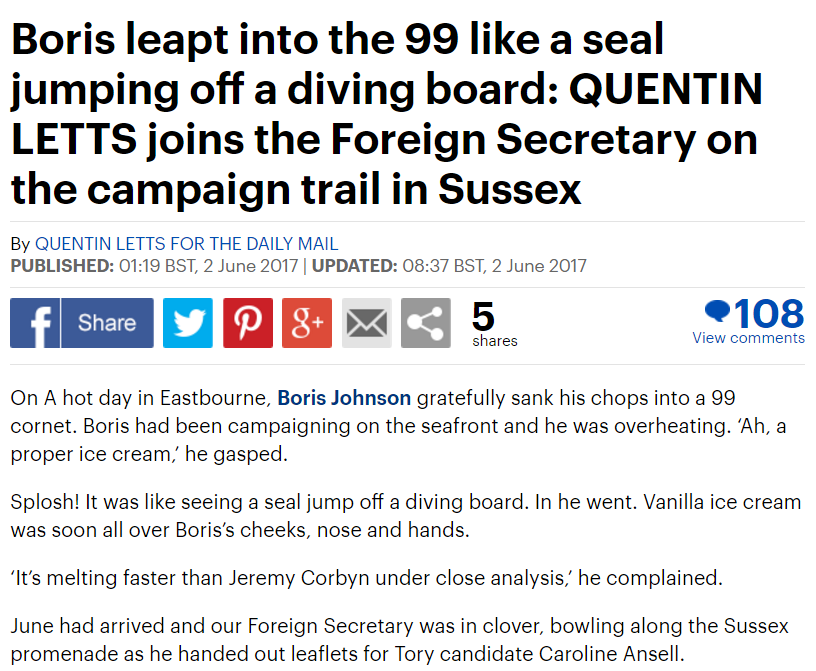
If one runs a Google search for Daily Mail articles on the Labour Party and Jeremy Corbyn, one can find hundreds and hundreds of them criticising and attacking. The same newspaper's treatment of the Conservatives and Theresa May? Pretty clement, even towards Boris Johnson, the current incumbent of the people's Naughty Step:


In the end, this article is about Boris Johnson's masterful handling of an ice cream known in Britain as a 99 and nothing about policy at all. Funnily enough, there were no negative stories at all, except the one on the PM's refusal to attack Trump for pulling out of the Paris Agreement, and a mild one on her decision not to go to the BBC debate. Press bias is a feature of both the left and the right, and although left-wing ones are quite strong, they don't hit nearly as hard. Nowhere is it more vitriolic and more effective in its premeditated viciousness and underhand manoeuvres than in the hands of the right-wing media. They manipulate stories, change angles and points of view depending on who they are defending or attacking. But now, the tide is turning and many reasonably-minded press outlets are calling them out. Here is one of those, handled very effectively by the Huffington Post.

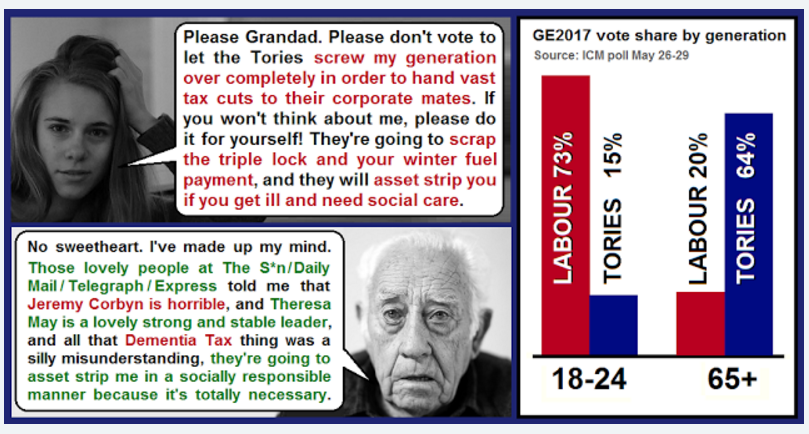
So, before you put your mark on the ballot paper next week, do a lot of research and question everything. You may even end up changing your vote preferences. For that reason, we need to get the message to the old. They are the ones most heavily influenced by newspapers, especially the right-wing press, and the ones most likely to vote. Demographically, in 5 to 10 years, there will be a lot fewer of them around, and my own feeling is this time is seen by the oligarchs in charge of the UK's press as being the final opportunity to make a landgrab for more wealth and influence.

Fortunately, the young are fighting back. Hundreds of thousands of new registrations to vote have been placed recently, and mainly by the young. This has caused a massive tilt in the opinion polls and a surge towards Labour, but these young people are notoriously languid on polling day. We can only hope they do go out to vote in their droves. The UK needs an effective opposition, especially if the Conservatives win a majority.

The Internet is full of images and graphics, like this one below, debunking the myths and lies spread by the right-wing media. The problem is, old people do not see these things, because newspapers do not have the same scope as the Internet, and so many old people are unaware of these simple issues.

(continued below the images)


These images containing meaningful messages are doing the rounds on the Internet, and so I challenge anyone with a family member over 60 who is without Internet: dig around for 5 to 10 simple yet effective memes of this kind, put it on your laptop or tablets and visit your relative to persuade him/her to vote for a party that wants to look after everyone.

Let us face it, the old have had their day. They need to be told the world will still be going on once they have departed, and it will most certainly not be the same world we have now. The elderly need to be persuaded that in fact, they do not have to put up with the decisions they make. The young do. Make way for youth, go and persuade your grandad to stand aside for the benefit of his descendants.

Saturday, 23 June 2007

Brussels Treaty: Mrs Thatcher lives on!

I sometimes read the tabloid press. Not because I enjoy doing so, but because I like to see what the enemy is doing. Tabloid journalism in the UK is the single biggest contributor to ignorance and naïveté amongst the average Briton, especially when it comes to the world at large.

FRONT PAGE NEWS:
SOME STAR HAS ANOTHER STAR'S BABY

SECOND PAGE NEWS:
VITRIOLIC RUBBISH ON ANYTHING WHICH WILL MAKE THIS PAPER SELL

THIRD PAGE NEWS:
NONE - JUST A NAKED LADY AND SOME SEXIST RHETORIC ABOUT HER

FOURTH TO TWELFTH PAGE NEWS:
9-PAGE FEATURE ON HOW YOU CAN IMPROVE YOUR SEX LIFE BY LISTENING TO FARM ANIMALS INTERSPERSED WITH SHORT ARTICLES ON FUNNY OR WEIRD TRIVIA

Thirteenth page news:
There's a war on in Iraq and Chirac is no longer President of France PLUS BIG ADVERT FOR PLASTIC SURGERY

FOURTEENTH TO TWENTY-FIFTH PAGE NEWS:
WHAT THE RICH, FAMOUS AND PERVERTED HAVE BEEN UP TO RECENTLY

blablabla, adverts, insurance cons, schemes to rip off old people, holiday ads, horoscopes, recipes, useless gadgets, telephone sex for sale, etc. etc.

SIXTIETH TO BACK PAGE NEWS:
SPORT, GAMBLING, RUMOURS OF BIG MONEY FOOTBALL TRANSFERS

The type of "person" who reads the tabloid press is the same one who would spend a decadent amount of money voting in TV reality shows but would find it hard to name his/her local Member of Parliament, and would have little idea as to what policies they have.

OK, I admit, this type of person exists all over Europe, but on a far greater extent in the UK. You just need to take a five-minute walk down the High Streets of Orpington, Gravesend or Chatham to realise how widespread they have become. So when I was reading several articles and forums, not only from the tabloid press, concerning this weekend's crucial European Summit and treaty, I was horrified to see how naïve people are on this matter, and how fearful they are of anything non-British.

"Sold to Europe!"
"Bliar has tied us to a European superstate" (note spelling of PM's name)
"Let's get out before it's too late!"
"No to any undemocratic treaty"
and the list goes on.

In order to see what kind of journalism breeds this lack of understanding and mind-boggling isolationism, you only need to look at a tabloid newspaper's website.

One article which made me embarrassed to be British was this one:
http://www.thesun.co.uk/article/0,,2-2007280672,00.html

And I decided to write the editor an email:

Dear Mr Pascoe-Watson,

Having read your article comparing Tony Blair to either Napoleon or Wellington, I find it hard to digest that Thatcherite jingoism can still have a place in 21st century Europe.
Times have moved on now.


The world is forming into power blocs of allies, including Europe, looking after each other's interests and assuring the UK of a higher profile and a louder voice at the world table.
Mr Blair did not sign up to the Charter of Fundamental Rights because it gets in the way of his draconian clampdown on British people's legal status. It means that all the historically retarded readers of the tabloids have encouraged Mr Blair to make the UK the most spied upon Orwellian nation on Earth, and you think it is a good thing, simply because this piece of legislation was not made solely by a British politician.


Let us face matters: you would prefer an independent British police state to a European law protecting your rights to be innocent BEFORE proven guilty, unlike the recent unilateral UK Home Office decision to detain people for long periods even if they may be innocent.
The Empire is long past. English-speaking countries are no better allies, not least the US, who made the UK pay every penny back for the Second World War, and still anti-Europeans harp on about how strong allies we are. Wake up little England, and smell the coffee.


If British anti-Europeans don't like the feeling of being in Europe because they feel the rules are being made elsewhere, just remember one thing: fighting your corner as a member who is taken seriously is better than skulking around on the periphery where nobody wants to notice you.
The only other leader who had any objections to the procedings this weekend was Mr Kaczynski of Poland - and just ask any educated Pole what they think of him.


The only reasons why Brits are universally disliked is firstly on evidence in the tourist resorts of Ibiza, Torremolinos and Corfu, and secondly on the political stage where the contributors to forums and blogs are right now vilifying any European project, whether it be for our benefit or not. And upon viewing their appalling spelling and grammar it is no wonder: they do not seem to take in basic linguistic rules, so they'll read and agree with every acidic demagogical syllable so artfully paraphrased in the negative to suit their small, monolingual worlds they wish to wallow in.

It is sad when a once-mighty nation has more voters in the Big Brother final than in the general election. It just shows you how little people really care about what is good for them.
Still, I admire your journalistic guile! Do you really believe what you write, though?


Yours Sincerely,

Raymond Goslitski

God, I needed that. I feel so much better now.

If the European Union has one failing though, it is that it has not promoted itself in the right way. It has good ideas, some excellent in fact. But it hides its light under a bushel. It doesn't seem to let people know why it can be a force for good, and what it has done to make our European continent a good place to live in. And that is where the battle against the hardline Euro-sceptics can be won.