Showing posts with label Telegraph. Show all posts
Thursday, 24 August 2017
There's a big reason why the UK may not actually leave the EU
Switch on your TV and some politician, no matter what side of the fence they sit on, will say "the British people voted to leave the EU, and that's what we're going to do". There are Remainer members of the public who say "we accept the result of the referendum and we have to abide by it". But deep inside the minds of many, there is a profound sense of having made a terrible mistake. As every day passes, more and more articles in the mainstream press, including even the most rabidly fervent pro-Brexit papers, are appearing, containing bad news on the UK's withdrawal from the EU.
This is to me a sign that most newspapers, including the vitriolically parochial Express and the excrescent Mail, didn't really believe the UK was going to actually go through with voting to leave the EU, but had found a niche in propagating xenophobic lies for profit, and now they have fulfilled their readers' wishes, they don't quite know which way to go and seem to be hedging their bets... added to this is a fightback by the readers - lots of replies to articles expressing regret, apportioning blame and venting anger. Here, I list some recent articles to make my point:
This article from the Mail admitting that Brexit is not yielding the bounty it was supposed to:
http://www.dailymail.co.uk/money/comment/article-4784688/The-Brexiteers-lost-economic-argument.html
This article, with a link to The Spectator, detailing how the chief director of the Leave campaign admits to lying to achieving his goal:
http://www.europeanscom.eu/leave-director-admitted-the-brexit-referendum-was-won-by-lying-to-the-public/
Business Insider reports that the promise of more manufacturing jobs is also not true:
http://www.businessinsider.de/commerzbanks-peter-dixon-on-uk-manufacturing-after-brexit-2017-8?r=UK&IR=T
Prospect Magazine has an interesting piece on how civil servants have told the government that the UK will have to choose between the US and EU trade models as it is too small and insignificant to set up its own (it seems to have sided with the EU, unless Liam Fox has his way):
https://www.prospectmagazine.co.uk/politics/government-ecj-paper-european-britain
There's this piece from the Telegraph, of all places, suggesting immigration figures were exaggerated:
http://www.telegraph.co.uk/news/2017/08/23/immigration-figures-review-new-checks-suggest-numbers-far-lower/
The Daily Mail also reports this:
http://www.dailymail.co.uk/news/article-4819922/Net-migration-Britain-100-000-LOWER.html
It's OK to report these things after having voted to leave the EU - nice bit of track-covering: when Brexit blows up in everyone's faces, they can say proudly, "we told you so!" (whatever the situation).
We also have a surprise entry from Putin's mouthpiece, RT, who want to inform us that people have started to regret their decisions:
https://www.youtube.com/watch?v=ABD-EZLVeRs
This BBC report talks about the exodus of foreign workers and the reluctance of many to go to the UK to work:
http://www.bbc.com/news/uk-41036236
It is backed up by this Reuters report:
http://uk.reuters.com/article/uk-britain-economy-food-idUKKCN1B32Q1
The Financial Times argues that giving up influence in Europe will not enhance influence elsewhere:
https://www.ft.com/content/d9e595d0-8750-11e7-bf50-e1c239b45787
This article from Pound Sterling Live says in a very discreet and indirect way that the pound is not going to go too much lower against the Euro (currently €1.09 to £1.00) because J.P. Morgan says it looks like hard Brexit is not going to happen (they even lower their odds from 25% to 15% on the chances):
https://www.poundsterlinglive.com/gbp-live-today/7363-gbp-to-eur-and-usd-forecast-update-jp-morgan
Here, we see the Pound Sterling as reported in the Independent, as the worst-performing of all major currencies:
http://www.independent.co.uk/news/business/news/uk-economy-growth-q2-2017-half-eurozone-eu-europe-second-quarter-a7909706.html
OK, the Guardian is the most pro-EU of all the papers, but it has this interesting editorial where, reading between the lines, it seems the government has given up on its hard Brexit wishlist:
https://www.theguardian.com/commentisfree/2017/aug/23/the-guardian-view-on-uk-brexit-policy-this-time-the-lady-is-for-turning
This one from the Welsh Daily Post concerns the effects of Brexit that are already biting:
http://www.dailypost.co.uk/business/business-news/axe-threat-nearly-100-workers-13513704
These are just some of the articles reporting the slow demise of Brexit. There are also many books, speeches and reports by all types of experts, professionals and those in business claiming Brexit is gradually being dumped:
This book is especially poignant:
https://www.amazon.co.uk/dp/B06Y15DBTG/ref=dp-kindle-redirect?_encoding=UTF8&btkr=1
It is called "Brexit, No Exit: Why Britain (in the End) Won't Leave Europe" by Denis MacShane, and it goes into detail about how the UK (and the West in general) reached the point of protectionism and anti-globalisation but this may be just a blip.
All-in-all, it is slowly but surely becoming clear to many people that the promises made last summer to the people of the United Kingdom were based on blatant lies, false premises and pipe dreams in an attempt to make the common man and woman vote to leave the European Union without realising the full ramifications. The government is going through the motions to make it seem they are still going ahead with it, but it is becoming more and more unlikely - impossible even - by the day.
Friday, 2 June 2017
UK Election 2017: tell your old folks their time is up
We live in an age where the source of your news will determine who you vote for and where in the social pyramid you probably find yourself. Most people will read from a news source, but there are stark differences in how those news sources treat various events and deal with diverse opinions. For one newspaper a scandal, for another an amusing anecdote. For one TV news broadcaster a waste of money, for another a long-term solid investment. Who to believe? And why does it matter to read all different sources of news?
My grandfather, who was also my uncle (long story cut short - my mother and her mother married two brothers), once gave me a very important life lesson. I asked him one day why he read a left-leaning newspaper but also a right-leaning one. His answer was clear: you have to know what the enemy is up to. I have never forgotten that line and I have stuck by it ever since.
Today, we live in a multi-faceted media world. We can get our news from someone's Facebook feed, or feeds from sources we ourselves have accepted. We can get it from watching Sky, Fox, ITN, or the BBC. Indeed, we can find it from a rejected newspaper in the train, or maybe we buy our newspapers at the corner shop every morning.
Newspaper readers in particular are very difficult to wean off their paper of choice. You could never give a Sun reader the Guardian and presume they will like it immediately. And vice-versa. Besides, it is not just a question of politics - it is also a matter or familiarity, intellect and taste. But it really matters. Because getting your information from one source is detrimental to acquiring a balanced opinion. Malcolm X once said, "If you aren't careful, the newspapers will have you hating the people who are being oppressed and loving the people who are doing the oppressing." If you stick to one source of news, over time, you are likely to believe everything written in there.
I acquire my news from the BBC, the Guardian, Mail Online and the Independent. I sometimes read the Economist, the Telegraph and watch Channel Four News on their website. I also see a lot of posts on Facebook from very diverse outlets such as Al Jazeera, CNN, and France 24. Most treat issues with the same seriousness and neutrality. Some find a unique angle to report from, some give statistics, some show a non-commentary video to tell the story. But the vast majority do not try to influence you one way or the other, because most of us accept certain issues as already fact, or because the news outlet wants you to make up your own mind through what they present. That is not always the case when it comes to politics.
That brings me on to the upcoming general election in the UK.
Where to begin? Let us start with the spin and the influencing. Take Theresa May's non-appearance at the BBC Election Debate on Wednesday night. She was replaced by the Home Secretary, Amber Rudd. Predictably, the left-wing press said this was a mistake, and she was scared of meeting the people, terrified of debates and not interested in ordinary people. The right-wing press predictably said it was not worth her turning up as it was a waste of time because twice as many people were watching BGT on ITV and because she was out on the streets instead, talking to the people who matter.
Where does the truth lie here? It probably lies somewhere in the middle - Theresa May knew a few weeks ago that she was a country mile in front, so she thought it best to steer clear of controversy and stay on-message, however sterile and boring that is. Saying that, I would say this was a bad error of judgement, as it gave five of the other six debaters the chance to stick in the sword.
Then there were the debates themselves and how they were reported. I watched the last half, and I saw highlights of the rest on highlights clips on YouTube and Facebook. I thought Jeremy Corbyn, Tim Farron, Angus Robertson, Caroline Lucas and Leanne Wood were quite eloquent, but they spent a long time attacking each other and especially the Tories, and not enough time talking about their own party's credentials. Amber Rudd was robotic and smiled when the audience laughed at her comments, like "judge us on our record". It was as if she knew this was just a soundbite, and she realised the audience knew as well. Paul Nuttall was like a builder's bumcrack at a society ball. He was excess to requirements. He got nearly no applause and when he opened his mouth to speak, he came across like Sean Spicer's less talented stand-in.
How did the newspapers report it?
Take a look at this article in the Guardian, on how biased the media has been behaving against Jeremy Corbyn, which seems to have a lot of credence. This one attacks Corbyn for befriending terrorists, this one shows Corbyn as a security risk, and this one bemoans the left-wing bias of the BBC. They're all from the Daily Mail.
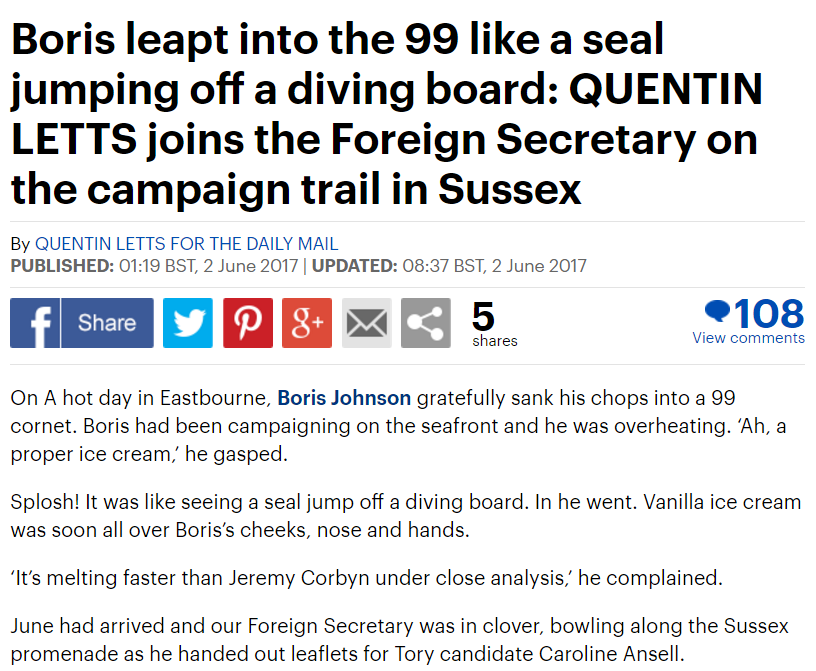
If one runs a Google search for Daily Mail articles on the Labour Party and Jeremy Corbyn, one can find hundreds and hundreds of them criticising and attacking. The same newspaper's treatment of the Conservatives and Theresa May? Pretty clement, even towards Boris Johnson, the current incumbent of the people's Naughty Step:
In the end, this article is about Boris Johnson's masterful handling of an ice cream known in Britain as a 99 and nothing about policy at all. Funnily enough, there were no negative stories at all, except the one on the PM's refusal to attack Trump for pulling out of the Paris Agreement, and a mild one on her decision not to go to the BBC debate. Press bias is a feature of both the left and the right, and although left-wing ones are quite strong, they don't hit nearly as hard. Nowhere is it more vitriolic and more effective in its premeditated viciousness and underhand manoeuvres than in the hands of the right-wing media. They manipulate stories, change angles and points of view depending on who they are defending or attacking. But now, the tide is turning and many reasonably-minded press outlets are calling them out. Here is one of those, handled very effectively by the Huffington Post.
So, before you put your mark on the ballot paper next week, do a lot of research and question everything. You may even end up changing your vote preferences. For that reason, we need to get the message to the old. They are the ones most heavily influenced by newspapers, especially the right-wing press, and the ones most likely to vote. Demographically, in 5 to 10 years, there will be a lot fewer of them around, and my own feeling is this time is seen by the oligarchs in charge of the UK's press as being the final opportunity to make a landgrab for more wealth and influence.
Fortunately, the young are fighting back. Hundreds of thousands of new registrations to vote have been placed recently, and mainly by the young. This has caused a massive tilt in the opinion polls and a surge towards Labour, but these young people are notoriously languid on polling day. We can only hope they do go out to vote in their droves. The UK needs an effective opposition, especially if the Conservatives win a majority.
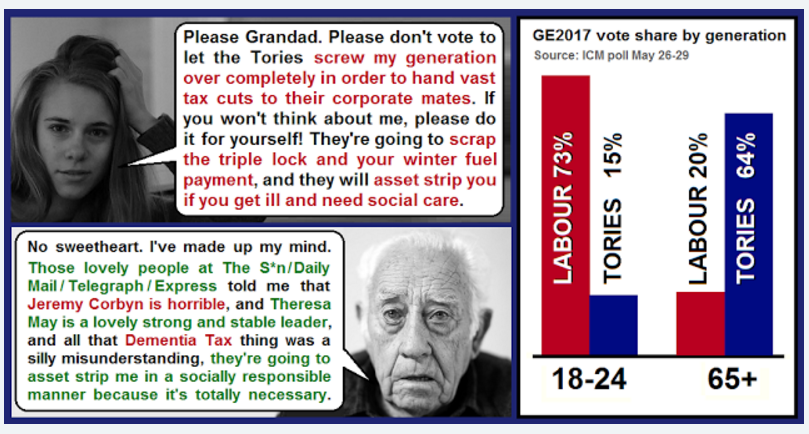
The Internet is full of images and graphics, like this one below, debunking the myths and lies spread by the right-wing media. The problem is, old people do not see these things, because newspapers do not have the same scope as the Internet, and so many old people are unaware of these simple issues.
(continued below the images)
These images containing meaningful messages are doing the rounds on the Internet, and so I challenge anyone with a family member over 60 who is without Internet: dig around for 5 to 10 simple yet effective memes of this kind, put it on your laptop or tablets and visit your relative to persuade him/her to vote for a party that wants to look after everyone.
Let us face it, the old have had their day. They need to be told the world will still be going on once they have departed, and it will most certainly not be the same world we have now. The elderly need to be persuaded that in fact, they do not have to put up with the decisions they make. The young do. Make way for youth, go and persuade your grandad to stand aside for the benefit of his descendants.
My grandfather, who was also my uncle (long story cut short - my mother and her mother married two brothers), once gave me a very important life lesson. I asked him one day why he read a left-leaning newspaper but also a right-leaning one. His answer was clear: you have to know what the enemy is up to. I have never forgotten that line and I have stuck by it ever since.
Today, we live in a multi-faceted media world. We can get our news from someone's Facebook feed, or feeds from sources we ourselves have accepted. We can get it from watching Sky, Fox, ITN, or the BBC. Indeed, we can find it from a rejected newspaper in the train, or maybe we buy our newspapers at the corner shop every morning.
Newspaper readers in particular are very difficult to wean off their paper of choice. You could never give a Sun reader the Guardian and presume they will like it immediately. And vice-versa. Besides, it is not just a question of politics - it is also a matter or familiarity, intellect and taste. But it really matters. Because getting your information from one source is detrimental to acquiring a balanced opinion. Malcolm X once said, "If you aren't careful, the newspapers will have you hating the people who are being oppressed and loving the people who are doing the oppressing." If you stick to one source of news, over time, you are likely to believe everything written in there.
I acquire my news from the BBC, the Guardian, Mail Online and the Independent. I sometimes read the Economist, the Telegraph and watch Channel Four News on their website. I also see a lot of posts on Facebook from very diverse outlets such as Al Jazeera, CNN, and France 24. Most treat issues with the same seriousness and neutrality. Some find a unique angle to report from, some give statistics, some show a non-commentary video to tell the story. But the vast majority do not try to influence you one way or the other, because most of us accept certain issues as already fact, or because the news outlet wants you to make up your own mind through what they present. That is not always the case when it comes to politics.
That brings me on to the upcoming general election in the UK.
Where to begin? Let us start with the spin and the influencing. Take Theresa May's non-appearance at the BBC Election Debate on Wednesday night. She was replaced by the Home Secretary, Amber Rudd. Predictably, the left-wing press said this was a mistake, and she was scared of meeting the people, terrified of debates and not interested in ordinary people. The right-wing press predictably said it was not worth her turning up as it was a waste of time because twice as many people were watching BGT on ITV and because she was out on the streets instead, talking to the people who matter.
Where does the truth lie here? It probably lies somewhere in the middle - Theresa May knew a few weeks ago that she was a country mile in front, so she thought it best to steer clear of controversy and stay on-message, however sterile and boring that is. Saying that, I would say this was a bad error of judgement, as it gave five of the other six debaters the chance to stick in the sword.
Then there were the debates themselves and how they were reported. I watched the last half, and I saw highlights of the rest on highlights clips on YouTube and Facebook. I thought Jeremy Corbyn, Tim Farron, Angus Robertson, Caroline Lucas and Leanne Wood were quite eloquent, but they spent a long time attacking each other and especially the Tories, and not enough time talking about their own party's credentials. Amber Rudd was robotic and smiled when the audience laughed at her comments, like "judge us on our record". It was as if she knew this was just a soundbite, and she realised the audience knew as well. Paul Nuttall was like a builder's bumcrack at a society ball. He was excess to requirements. He got nearly no applause and when he opened his mouth to speak, he came across like Sean Spicer's less talented stand-in.
How did the newspapers report it?
Take a look at this article in the Guardian, on how biased the media has been behaving against Jeremy Corbyn, which seems to have a lot of credence. This one attacks Corbyn for befriending terrorists, this one shows Corbyn as a security risk, and this one bemoans the left-wing bias of the BBC. They're all from the Daily Mail.
If one runs a Google search for Daily Mail articles on the Labour Party and Jeremy Corbyn, one can find hundreds and hundreds of them criticising and attacking. The same newspaper's treatment of the Conservatives and Theresa May? Pretty clement, even towards Boris Johnson, the current incumbent of the people's Naughty Step:
In the end, this article is about Boris Johnson's masterful handling of an ice cream known in Britain as a 99 and nothing about policy at all. Funnily enough, there were no negative stories at all, except the one on the PM's refusal to attack Trump for pulling out of the Paris Agreement, and a mild one on her decision not to go to the BBC debate. Press bias is a feature of both the left and the right, and although left-wing ones are quite strong, they don't hit nearly as hard. Nowhere is it more vitriolic and more effective in its premeditated viciousness and underhand manoeuvres than in the hands of the right-wing media. They manipulate stories, change angles and points of view depending on who they are defending or attacking. But now, the tide is turning and many reasonably-minded press outlets are calling them out. Here is one of those, handled very effectively by the Huffington Post.
So, before you put your mark on the ballot paper next week, do a lot of research and question everything. You may even end up changing your vote preferences. For that reason, we need to get the message to the old. They are the ones most heavily influenced by newspapers, especially the right-wing press, and the ones most likely to vote. Demographically, in 5 to 10 years, there will be a lot fewer of them around, and my own feeling is this time is seen by the oligarchs in charge of the UK's press as being the final opportunity to make a landgrab for more wealth and influence.
Fortunately, the young are fighting back. Hundreds of thousands of new registrations to vote have been placed recently, and mainly by the young. This has caused a massive tilt in the opinion polls and a surge towards Labour, but these young people are notoriously languid on polling day. We can only hope they do go out to vote in their droves. The UK needs an effective opposition, especially if the Conservatives win a majority.
The Internet is full of images and graphics, like this one below, debunking the myths and lies spread by the right-wing media. The problem is, old people do not see these things, because newspapers do not have the same scope as the Internet, and so many old people are unaware of these simple issues.
(continued below the images)
These images containing meaningful messages are doing the rounds on the Internet, and so I challenge anyone with a family member over 60 who is without Internet: dig around for 5 to 10 simple yet effective memes of this kind, put it on your laptop or tablets and visit your relative to persuade him/her to vote for a party that wants to look after everyone.
Let us face it, the old have had their day. They need to be told the world will still be going on once they have departed, and it will most certainly not be the same world we have now. The elderly need to be persuaded that in fact, they do not have to put up with the decisions they make. The young do. Make way for youth, go and persuade your grandad to stand aside for the benefit of his descendants.
Labels:
2017,
Amber Rudd,
Boris Johnson,
Conservative,
Daily Mail,
Economist,
election,
Greens,
Jeremy Corbyn,
Labour,
left-wing,
Paul Nuttall,
Plaid Cymru,
Right-wing,
SNP,
Telegraph,
Theresa May,
Tories,
UKIP
Subscribe to:
Posts (Atom)